A complete guide to Breast Augmentation Scars
Scars are a natural part of the healing process. The goal is to make your scar as small and discreet as possible. It is important to remember that cosmetic surgery scars and healing progression can vary depending on the type of procedure, the surgeon and the individual.

STITCH SENSE
The experienced consultant cosmetic surgeons at Bella Vou use stitching techniques and materials designed to reduce discomfort and improve healing.

DISCREET SCARS
The Consultant Cosmetic Surgeons at Bella Vou understand the importance of careful scar placement. Not only do their world-class suturing techniques ensure that the scars are very fine, but they will always make every effort to place scars where they will go unnoticed.

SCAR CLINIC
Throughout your recovery with Bella Vou, you will attend regular sessions with our dedicated Scar Clinic to help support healthy healing. Our in-clinic wound specialists will monitor your progress, assess scar formation, and provide expert care to ensure optimal outcomes.
To achieve the best scar outcome, consider these expert-backed tips:
-
Follow Post-Op Instructions: Keep incisions clean and avoid excessive movement.
-
Use Silicone Sheets or Gels: These can help flatten and fade scars faster.
-
Massage the Scar: Once healed, gentle massage can improve blood flow and break down scar tissue.
-
Stay Hydrated and Eat Well: Good nutrition supports skin regeneration.
-
Avoid Smoking and Alcohol: These hinder healing and can worsen scarring.
-
Sun Protection: Keep scars covered or use sunscreen (SPF 30+) to prevent darkening.
Even after the initial healing phase, scars require ongoing care to maintain a smooth appearance.
-
Use Moisturisers and Vitamin E: Hydration keeps scars supple.
-
Consider Professional Treatments: Laser therapy, microneedling, or steroid injections can improve scar appearance.
-
Monitor for Unusual Changes: Any excessive redness, pain, or raised scars may need medical attention.
1 Week

During the first few days after surgery, the incision site will be swollen, bruised, and may ooze a small amount of blood or fluid. It is important to keep the area clean and dry, and follow any instructions given by your surgeon for wound care. You may also experience some pain and discomfort, which can be managed with medication. Right after surgery, breasts appear high and firm due to swelling and implant placement. They may seem unnaturally high on the chest.
6 Weeks
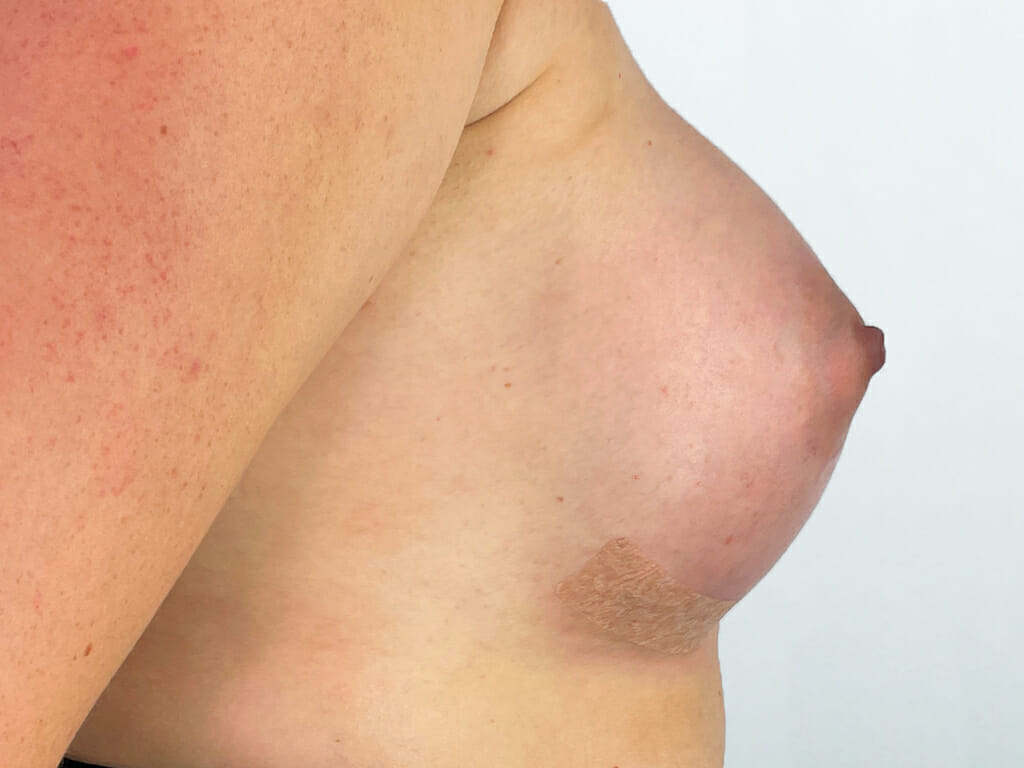
After a week or so, the incision site will begin to form a scar. The scar will be pink or red in color, raised, and firm to the touch. This is a normal part of the healing process and the scar will begin to fade over time. Swelling gradually subsides, and implants start to settle into a lower position. Breasts become softer, and the upper pole fullness decreases.
4 Months

Over the next few weeks and months, the scar will continue to mature and soften. It may change colour and become less noticeable. It is important to avoid exposing the scar to direct sunlight, as this can cause it to darken. As tissues relax, the lower breast begins to fill out, creating a more natural contour. Implants drop further into place, improving shape and symmetry.
5 Months

The final results are beginning to show, the tissues continue to relax, the lower breast continues to fill out, creating a more natural contour. Implants drop further into place, continuing to improve shape and symmetry.
6 Months

The scar will continue to mature and soften. It may change colour and become less noticeable. It is important to avoid exposing the scar to direct sunlight, as this can cause it to darken. The breasts continue to achieve their desired shape. This stage varies by individual, with full results typically realized around one year post-op.
1 Year

The scar will continue to mature and soften, being barely visible, It is important to avoid exposing the scar to direct sunlight, as this can cause it to darken. The breasts have achieved their desired shape, settling into their permanent position.
It is important to follow your surgeon's post-operative instructions carefully and attend all follow-up appointments to ensure the best possible healing and cosmetic results.
Frequently Asked Questions
Scars are typically located at the incision site, which may be under the breast crease (inframammary), around the nipple (periareolar), in the armpit (transaxillary), or near the belly button (TUBA).
The Consultant Cosmetic Surgeons at Bella Vou understand the importance of careful scar placement. Not only do their world-class suturing techniques ensure that the scars are very fine, but they will always make every effort to place scars where they will go unnoticed. Most frequently, Breast Augmentation scars will be placed under the breast crease at Bella Vou.
Scars generally take 6-12 months to fade significantly, but full maturation can take up to 2 years.
Yes, silicone-based gels and sheets, vitamin E, and scar-reducing creams can help minimize scars over time.
Yes, experienced surgeons using precise techniques can reduce scarring. Endoscopic methods and minimal-incision approaches may also help.
The experienced consultant cosmetic surgeons at Bella Vou use stitching techniques and materials designed to reduce discomfort and improve healing. Not only do their world-class suturing techniques ensure that the scars are very fine, but they will always make every effort to place scars where they will go unnoticed.
Throughout your recovery with Bella Vou, you will attend regular sessions with our dedicated Scar Clinic to help support healthy healing. Our in-clinic wound specialists will review the healing process and the scar formation to get the optimum results.
Most scars fade significantly but may not disappear entirely. Proper care over time can make them less noticeable.
Larger implants may require longer incisions, potentially resulting in more noticeable scars. Implant placement and surgical technique also play a role.
More About Breast Augmentation Scar


What our clients say
★ ★ ★ ★ ★ 5 Star Average | 143 Reviews
★★★★★
I would 100% recommend Bella Vou. They have been so helpful, warm and professional all the way through my treatment journey. For many years my heavy hooded eyelids were bothering me and I had be planning to have it done at some point, my only regret is not booking it sooner. From the initial consultation, leading up to surgery, the procedure and out surgery. I was very anxious but a were so lovely and I felt reassured and in the best hands. Amir and his colleagues were fantastic, telling me what they were doing, what to expect. I couldn’t have asked for more. The service post surgery has been next to none, people to contact 24/7, phone check up, follow up appointments and everyone has been attentive and responsive. If you are considering this surgery or any other then don’t put it off, book a consultation, you will not regret it.
Anon
★★★★★
I would highly recommend Bella Vou if you’re considering any kind of cosmetic surgery especially Dr Amir. From the moment I stepped into Bella Vou I felt so welcome & relaxed every member of staff is so friendly and can’t do enough for you. I had done some of my own research into the clinic before my consultation with Dr Amir but every video I had watched and reviews I read were exactly who he was in person kind, caring & very knowledgeable he listened to everything I wanted to achieve. My amazing patient coordinator is Julia she is so lovely and couldn’t do enough for me, she has been so reassuring and such a friendly face to see whenever at the clinic, always on hand to answer any questions I couldn’t have gone through this all without her. My surgery went really well, Amir is incredible at what he does. I was so well cared for & the rooms are spotless. I was sent home with all my medication & a timed schedule when they needed to be taken. I was also offered the Chaucer service to my 1 week post op appointment, my driver Andy was very friendly & held good conversation. I also received a beautiful bunch of flowers a week after my surgery which was a lovely little touch. I’m just under 2 weeks post op and almost back to normal, I’m excited to see my results over the next coming weeks/months. Bella Vou really is the best clinic, all the small touches will make your journey with them so special. I can’t thank them all enough!
Anon
★★★★★
I had my breast augmentation done 2 weeks ago so final results are yet to be seen but I’m absolutely over the moon so far, I had a breast lift and implants done after having 2 children and I’m so impressed with how good they look. I was feeling so nervous about having a consultation but Amir and the team put me Completely at ease, from the minute I entered the building I knew I had chosen the right place, from consultation to after care I cannot fault anything, Iv never met such a team of lovely people. Iv been so well looked after before and after surgery and I would 100% recommend Bella Vou and Amir over and over again. Thankyou so much for giving me my confidence back! Outstanding team of people.
Anon
★★★★★
I am almost 4 weeks post surgery, I had a breast uplift and a thigh lift. Amir was my surgeon and I couldn’t have chosen a better one, from the first meeting he was so open and so honest with everything , which I really appreciated, he filled me with much needed confidence and I felt that I would be able to love myself after having my surgery having discussed everything with him and what to expect. I am so grateful to him, after losing 7 stone in weight and being left with excess skin and breasts that were empty I decided to go to Bella vou which is something I never thought I would do, but it had changed my life, I am amazed at what Amir has done especially with my breasts as I really didn’t believe they would even resemble a breast again, but I am sat here today with two perfectly pert breasts and I love them !! I never thought I would say that. My thighs are incredible too, they look so shaped and toned and I now know I will feel confident enough to be able to wear bikini bottoms and not have to ever worry again . Everybody at Bella vou has been amazing, from the lovely lady on reception, to the lovely lady upstairs who keeps you comfortable with drinks and biscuits. Also I have to say a huge thankyou to Nikki Pinkney , throughout my time here she has been amazing and I’m so grateful to have met such a lovely lady . Overall I do not regret a thing , Amir is incredible and I’m so grateful to him. Bella Vou is a beautiful place full of beautiful people and I can’t thank them all enough.
Anon
★★★★★
What can I say?! Having worked as a midwife in the NHS for 30 years I can honestly say that Rado is up there with the best! I had the full works: a 360 circumferential abdominoplasty, abdominal hernia repair, four areas of liposuction and a breast uplift – and somehow, I still came out smiling (and very snatched!). From start to finish, Rado, my surgeon, was a complete superstar; honest, approachable, kind, and always up for answering my many (many!) questions without making me feel silly – a rare combination of warmth and professionalism. He’s not one of those surgeons who gives you the hard sell or disappears once the surgery is done. He genuinely cares about his patients (yes, really cares – not just the polite kind). You can tell he wants the absolute best outcomes, and his surgical skills are absolutely top-tier. I trusted him with my body, and he gave me back confidence, comfort, and a waist I hadn’t seen in years! If you’re considering surgery and want someone who’s not just brilliant with a scalpel but also a lovely human being – look no further. You’ll be in the best (and very steady) hands.
Anon
★★★★★
I had such a positive experience with Rado. From the initial consultation right through to surgery. He was very detailed with what to expect from the surgery, what the outcome would be and how the surgery would be performed. I felt so confident about my decision to have surgery there is no way I would consider going anywhere else. I would recommend in a heartbeat.
LJL26
★★★★★
Dr Rado & Team was absolutely amazing, I had the most outstanding service, the team went above and beyond, I was made to feel.ao incredibly comfortable the whole time, I had surgery in perfect time. Thank you Bella Vou amd especially Dr Rado for giving me confidence to enjoy myself
KIirsty90
★★★★★
I went to see Hagen for a consultation on some skin removal on my chin where i had previously had a chin reduction and the skin left left me very down and conscious. He was very kind and explained everything fully so we agreed on surgery which i was so happy about. On the day of the surgery he was very kind and reassuring i can’t thank him enough for his kindness and understanding and the nurses who are outstanding.
shannywick
★★★★★
I had an excellent experience with Dr. Hagen for my rhinoplasty. He was incredibly professional and reassuring throughout the entire process, taking the time to explain everything and make me feel at ease. The results have exceeded my expectations—healing has gone smoothly, and I’m so happy with how everything looks and feels. Dr. Hagen has continued to check in on me post-surgery, which shows how much he cares about his patients. I’m truly grateful and highly recommend him.
Adventurous672614
★★★★★
I’m male and had rhinoplasty with Hagan with the Bella Vou clinic. The whole thing was fantastic from start to finish. The clinic is patient led and goes the extra mile at every step. On top of this the procedure was far better value for money than clinics on Harley Street. The procedure went very well and I’m very happy with the outcome, now one week post op.
Cute655524
★★★★★
Hagen was professional throughout. He understood my concerns and explained the achievable outcome. Everyone at Bella Vou is kind, friendly and readily available to answer any questions and the clinic itself is beautiful. I’m 54 and finally took the steps to correct the sticky out ears that I’ve been hiding with my hair for most of my life. I’m so glad I did! I am really happy with the outcome of my ear pinning procedure. The procedure itself went well, and the team at Bella Vou are available all the way through the healing process. The initial consultation was informative and the after care has been excellent. If you are thinking of having an ear pinning procedure, I can highly recommend Hagen and Bella Vou.
Crabtree70
★★★★★
Mr Schumacher is informative and understanding throughout my experience with the surgery. From consultation to the surgery everything went smoothly, easy to talk to and helpful. I am satisfied to have Mr Schumacher to conduct the treatment.
Beautiful758357
★★★★★
I had an amazing experience at Bella Vou with surgeon Hagen for my Buccal fat removal. I felt reassured and comfortable throughout the whole experience. I have been very looked after by all the staff at Bella Vou and can’t thank them enough. I was informed extensively about my procedure and didn’t feel pressured into it at all. Hagen explained throughly what was to be expected and the complications that could arise. I am 2 weeks post surgery so I haven’t seen full results yet. Thank you all!
CaitCrome
★★★★★
Hagen is a highly skilled surgeon. My breast looks and feels amazing!! I made the right decision, I couldn’t be happier about my choice of surgeon. Hagen is very professional and helpful in every way. Together with Soile (patient coordinator)they made me feel very welcome, relaxed and answered all my questions with honesty. I do recommend Hagen to anyone who is thinking about breast surgery (I had breast enlargement and breast uplift)
Forceful512135
★★★★★
After having multiple facial surgeries (brow lift, cheek lift, and neck lift) with Hagen Schumacher at Bella Vou, and being very happy with the results, I decided to go ahead with a rhinoplasty. Of all the procedures I’d had, this was the one I was most concerned about, as the nose is such a central part of the face. I didn’t want a trendy or unnatural look, just my own nose, slightly reworked to suit the rest of my features. I discussed this with Hagen and showed him a few reference photos of how I hoped it could look. I couldn’t be more pleased with the outcome. I’m currently eight weeks post-op, and although there is still some swelling, the shape is already exactly what I wanted. My nose still looks like mine, just more balanced and refined. My neck lift was also exceptional, and my jaw and chin area are significantly improved. Hagen’s qualifications speak for themselves, but what makes his work stand out is his eye for detail and proportion. He always takes a conservative approach, and absolutely nothing on my face looks overdone or unnatural. He also guarantees his work and addresses any concerns or revisions without question. This, in my view, is incredibly important, as results aren’t always exactly as hoped the first time, and despite best efforts, revisions are sometimes necessary. I also want to thank the wider team at Bella Vou. Julia Ramos, my patient coordinator, has been excellent throughout. Any questions or issues were handled straight away. I developed a mild skin infection and sent photos to Hagen, who immediately issued a prescription. Julia then arranged for it to be sent to my local pharmacy. Hagen and Julia work seamlessly together. The rest of the staff are also fantastic, from reception to theatre staff, and also the wonderful Nikki, who carries out the post-op MLD. I wouldn’t hesitate to recommend Hagen or Bella Vou. Hagen’s work is outstanding, and the experience at Bella Vou has been second to none. My sincerest thanks to you all.
Sociable946949 •
★★★★★
I recently had a breast augmentation and couldn’t be happier with my results. From my very first consultation Dr Hagen made me feel very comfortable and was very informative and my results are beyond my expectations. Dr Hagen has given me the confidence I’ve always dreamed of when it comes to my Breasts and I couldn’t thank him enough. Highly recommended and I wouldn’t hesitate in having any other surgeries in the future. Hagen is simply the best.
Anon
★★★★★
I recently had another surgery with Hagen Schumacher at Bella Vou to address what he identified as dynamic chin ptosis. I was happy with my chin at rest, but when I smiled, it would drop and make my face appear longer. Hagen explained that this was due to excess tissue and age, and he recommended a procedure to correct it. The results have been wonderful. Now, when I smile, my chin stays defined and no longer droops. This was combined with chin liposuction, and I now have the most refined chin contour I’ve ever had. I also want to note that this was the first time I was awake during surgery, which made me a bit nervous at first. However, Hagen was incredibly reassuring. He made sure I was comfortable, offered to pause or stop if needed, and I felt calm and in control throughout. I truly can’t thank him enough for his skill and patient care. A special thanks also to Julia Ramos for always ensuring I receive first-class service from Bella Vou. Overall, I highly recommend Bella Vou and Hagen to anyone considering this, or any other type of procedure
Sociable946949
★★★★★
Amazing experience at bella vou. From the complete start of the process right through to the end the service has been truly incredible. From the patient coordinator, staff, surgon. Everyone makes you feel at home. I had breast augmentation and im loving my results, I’m only 2 weeks post OP and feel amazing. Thank you so much to everyone you have changed my life x
Powerful944885
★★★★★
Hagen has been very informative about the Rhinoplasty procedure and he as well as all the staff at Bella Vou have been extremely kind and supportive throughout my experience. They go all out to ensure I am as comfortable as possible and even sent me home with a goody bag after my surgery. My surgery went extremely well. Usually after anaesthesia, I feel awful and groggy but after this op, I felt amazing. I’m not sure what they are doing differently to the NHS but it was a much better experience than I’ve ever had before. The follow ups have been highly informative and relaxing. They have called to check in a couple times and even sent a beautiful bouquet of flowers whilst I was recovering. I could not fault this clinic and would recommend to anyone looking to have treatment!
bethfisher6981
★★★★★
My rhinoplasty with Dr. Ion has had such a profound impact on me, it’s hard to put into words. I had always wanted to change my nose, but the idea of surgery was daunting. I worried I wouldn’t like the result and lacked the courage to take the leap. I spent hours researching, reading reviews, and consulting with different surgeons. But when I met Dr. Ion, I immediately felt confident in his expertise and knew I was in good hands. His calm, reassuring demeanor, attentiveness, and thorough explanations made me feel completely at ease—there was no rush, no pressure, just honest, thoughtful advice. The surgery itself went smoothly, and the aftercare was exceptional. Although I developed a small infection, which cleared up quickly with antibiotics, Dr. Ion was consistently there, checking on me and making sure everything was fine. As the swelling subsided and I saw the new shape of my nose, I was overwhelmed with joy. It felt like the nose I was always meant to have. To this day, I smile every time I look at myself in the mirror. The changes have gone far beyond just physical appearance. My confidence, self-esteem, and sense of self-worth have grown exponentially. It’s truly been a transformative experience. I will be forever grateful to Dr. Ion
Anon
★★★★★
I had revision rhinoplasty (with a rib graft) and a chin implant with Dr Lucian Ion, and I’m so incredibly happy with my results. Honestly, the whole experience was just perfect. Dr Ion is amazing. He’s kind, patient, and reassuring. I had so many questions and worries, especially because revision rhinoplasty is complicated and lots of surgeons I spoke to didn’t want to do it. They said it was too risky! But Dr Ion never hesitated . He’s really confident with difficult cases, and it shows. My results look completely natural, exactly like we’d discussed, and actually much better than I imagined. People didn’t realise I’d had surgery – even my close family members just commented that I looked really well, without suspecting any cosmetic procedures.. Initially, after surgery, I was worried about minor asymmetries, but Dr Ion reassured me they’d settle, and they did, exactly as promised. Within a few weeks, I was already socialising comfortably, and no one noticed anything unusual. Any residual asymmetries (which were only noticeable to me) resolved over the next few months. Also, one of the reasons I chose Dr Ion was because he’s a member of The Rhinoplasty Society, which is the most prestigious rhinoplasty group globally. They only accept surgeons who deal with the most complex cases and achieve excellent results. He’s actually one of the very few members based in London, which really shows how skilled he is. I really think he’s one of the best plastic surgeons out there, especially for tricky cases like mine, and I absolutely recommend him!!
Sensible431976
★★★★★
This was my 5th rhinoplasty following a rhinoplasty which made no difference and then 3 very botched revisions by the same (well known) surgeon. I approached a few other well know specialists at the same time as Mr Ion who all refused to even consider taking me on as a case. Mr Ion was patient and understanding throughout the whole process. He is clearly willing to take on the most complex cases which speaks volumes about his skill and character. The operation was extremely difficult due to my thin skin. It involved a rib graft and fascia. It has now been 4 years since the operation and I can honestly say it has changed my life. I no longer think about my nose. It is a very natural result which fits with my face. I am truly grateful to Mr Ion as I have been able to move forward with my life happy and confident.
Kale29292
★★★★★
I had a BA with Lucian nearly 3 weeks ago and so far I’m really happy with everything. The healing process is going really well and I can’t wait to see the end results. Unfortunately I had an unrelated illness medication allergy to a new medication I started just prior to my surgery but he supported me through the whole process, he sent me to A&E, told me what tests to run to rule out any complications with the BA and was calling me every hour to check on me. Thankfully it wasn’t the new girls but a severe reaction to my medication but even still he got me on for an extra check up to ensure I was doing ok and to check everything was healing beautifully. I honestly can not thank Lucian and everyone at Bella Vou enough for all their support. Updated on 30 Jun 2025: My whole journey from start to finish was absolutely amazing. I met Julia Ramos who was my patient coordinator and from the very first phone call she has been more than I could ever have hoped for, she has been kind, professional and so caring.My surgeon was Lucian Ion for a breast augmentation, the results are just superb, my confidence has soared and I am absolutely amazed at the results.My post op nurse was so attentive and caring, nothing was ever too much bother for her, even when my husband wanted a drink!I chose Bella Vou as my sister had a breast augmentation here 2 years ago and I am so glad I went with them, as every single moment has been beyond amazing.
Thoughtful837159
★★★★★
I saw dr ion in 2024 after two failed surgery under nhs . He is so kind and calm which immediately gave me reassurance . I felt instant truly that I am in safe hand . Someone you can trust . I was nearly 60 years old despite that Mr ion told me he can help me which gave me so much hope . I think he was the only surgeon I met that I feel safe . But I think by asking a few stupit question I lost Mr ion support . I did ask question not because I doubt Mr Ion only because I was under nhs and they were offering ear cartilage which I was sure it was a wrong choice for me . But by asking about ear cartilage again in my case I made big mistake and lost Mr ion support . That is my biggest regret of my life . I wish I never ask that question to lose his support . I still think he is one the most honest and nicest and talented surgeon in uk. I feel his patient are so lucky to be treated by some one like him .
Anon
★★★★★
I have had a few surgeries with Mr Ion and had never written a review as I am very private but on this occasion I feel this review may help others who have decided to have a breast ex-plant. I’d had my implants in for a very long time, 6 months after I had stopped breast feeding my last child. The implants were from the 1990s and one implant had started to rotate and become uncomfortable. Due to having other responsibilities, a General Anaesthetic was not an option for me. Mr Ion sent me for an ultrasound to establish extent of rupture if any and a BIA-ALCL test to rule out any signs of carcinoma that although rare is specific to breast implants that have a rough surface which was common use back in the 1990s. These tests were done at a nearby clinic and the results gave an all clear result much to my relief. My ex-plant was performed two weeks later under local anaesthetic and to be on the safe side another tissue biopsy was taken which also came back negative. I was worried about how awful my deflated breasts would look but Mr Ion reassured me that breast tissue can restore itself in time and that after 6 months I could decide whether I wanted new implants/ fat transfer or an uplift or all 3! The incisions are so neat and tidy and after a 4 week check up with Rosie the in-house super-nurse, I am now using scar tape and the scars are almost invisible already. The bonus is that my breasts really look very good 4 weeks later and indeed the tissue has bounced back and I now have volume! I am beyond pleased with the result! Mr Ion is a serious and talented surgeon who has a keen eye for the aesthetic. Always patient, thorough and trustworthy which are qualities one would expect in a top surgeon. The staff, in particular the office receptionists were always helpful and discreet and showed compassion throughout my treatment. I can only highly recommend and give Mr Ion 5 stars!
STHO
★★★★★
What can I say?! Having worked as a midwife in the NHS for 30 years I can honestly say that Rado is up there with the best! I had the full works: a 360 circumferential abdominoplasty, abdominal hernia repair, four areas of liposuction and a breast uplift – and somehow, I still came out smiling (and very snatched!). From start to finish, Rado, my surgeon, was a complete superstar; honest, approachable, kind, and always up for answering my many (many!) questions without making me feel silly – a rare combination of warmth and professionalism. He’s not one of those surgeons who gives you the hard sell or disappears once the surgery is done. He genuinely cares about his patients (yes, really cares – not just the polite kind). You can tell he wants the absolute best outcomes, and his surgical skills are absolutely top-tier. I trusted him with my body, and he gave me back confidence, comfort, and a waist I hadn’t seen in years! If you’re considering surgery and want someone who’s not just brilliant with a scalpel but also a lovely human being – look no further. You’ll be in the best (and very steady) hands.
Anon
★★★★★
Rado is such a lovely man and a fantastic surgeon. He gives good realistic advice. I found him very approachable, he always takes time for his patients. I never doubted him, even when my recovery from surgery wasn’t straightforward at the start. I have been supported by Rado and Julia, my patient coordinator every step of the way. From my chauffeurs Paddy and Joe (travel to and from Bella Vou when I couldn’t get a lift or drive myself) to Ann on the front of house, nothing is too much trouble for any of the staff. The nurses are amazing, Kelly and Gabriella looked after me so well. They really treat you like family! My results are something I used to dream about, but Rado really has made that dream a reality. I love checking in with him, he’s the funniest person you could meet, he makes you feel so comfortable. I’m so pleased I chose Bella Vou, Rado and his team will never truly know what they have done for me! If you’re on the fence; do it!!
Forceful735628
★★★★★
I had an amazing experience with Rado, He went through all the options with for a breast uplift after having children and losing a lot of weight. I had a breast uplift with dermal sling. I’m so happy with the results!
aimeelucas26
★★★★★
Dr Rado is amazing! As soon as I met him, I knew he was the surgeon for me. He made me feel comfortable and at ease with the procedure. He’s down to earth and honest and wow the results are incredible. My scar line is so thin and neat and I am over the moon with my results. I could not have asked for better results. Dr Rado is brilliant.
Butterfly1306
★★★★★
Dr Rado on my initial consultation was amazingly attentive to my concerns and carefully and transparently recommended the best practices to resolve them. I felt heard, seen and accepted. All aspects of my treatment, pre and post surgery were ten stars on repeat, I could not fault the Bella Vou team in any way. What I really loved about Dr Rado, was his care to detail, transparency and undeniable level of skill. I’ve healed well and couldn’t be more happy with my results. I loved walking through the Bella Vou door, and I’d highly recommend you do too if you need to.
Humorous54352
★★★★★
I had an extended tummy tuck with lipo and 2 hernia repairs. From the moment I met Rado he made me feel very comfortable and he has a lot of friendly banter too. He knew exactly what I needed and wanted and helped me gain a visual of what the outcome would be after the procedure. He is very caring aswell after the procedure I have spoken to him personally twice over the phone and I only had surgery two weeks ago. He and his team are always there if I have any questions or concerns. Updated on 16 Oct 2025: I had a brilliant experience with Rado from the first consultation right up to surgery day and beyond. I am only 4 weeks post surgery and I can already see a difference.Julia my patient coordinator has been and continues to be great. I could tell from the first moment I met her that she really cares about her patients. She checked in on me a few times in the first week of surgery, which I really appreciated. And when I go for my lymphatic massages she’s always welcoming and always willing to see how I am. Nikki who did 2 of my massages was incredible. She really made me feel at ease and we had a great laugh aswell. Overall, the whole Bella Vou team no matter who you see whether it’s just in passing or at the reception desk are all so nice and really make you feel special.If I was to have any other surgeries in the future I would definitely go back to Rado and this clinic.
emjem881
★★★★★
I had a 360 tummy tuck with Dr. Rado and I can honestly say it’s been one of the best decisions I’ve ever made. From the moment I walked into his office, I could tell that Dr. Rado genuinely cares about his patients. He took the time to listen to my concerns, explain every part of the process, and make sure I felt comfortable and informed every step of the way. His kindness and professionalism put me completely at ease. The surgery went so smoothly, and my recovery has been amazing. My scars are already barely visible, and I’ve never felt so confident in my body! I feel like I’ve been reborn. The results from my surgery have been even more amazing than I ever dreamed was possible. Dr Rado’s attention to detail and his dedication to achieving beautiful, natural results truly show in his work. The entire team at Bella Vou was just as wonderful — always supportive, patient, and encouraging. I never once felt rushed or like just another number. If you’re considering a tummy tuck I can’t recommend Dr. Rado enough. He’s not only an incredibly skilled surgeon but also someone who genuinely cares about helping his patients feel their absolute best. Thank you so much Dr Rado!
Aliceinchains
★★★★★
I can’t thank Bella Vou enough for what they have done for me. I had breast augmentation and an uplift and although I’m only a week and a half post surgery, I am absolutely delighted with the results. From the moment I walked into the clinic I was welcomed by such a lovely, friendly lady called Ann who straight away made me feel welcome & comfortable. My patient coordinator, Julia was amazing, so kind, friendly and spoke to me as though she really cared about me. I was quite anxious meeting my surgeon Rado but as soon as I walked into the room, I could just feel his warmth, friendliness and he put me at ease straight away. Rado is absolutely incredible at what he does, he is truly a genius! I honestly can’t thank him enough! The care I received was outstanding! They sent me the most beautiful bouquet of flowers after my surgery with a card. The nurses are amazing, everyone speaks to you as though you are equal to them which is such a lovely feeling as other clinics can feel as though they are above you. The clinic is so beautiful as well, it feels like a hotel/spa. It’s stunning. Once again I really can’t thank Bella Vou enough! They’ve changed my life for the better and I owe them everything! I would highly recommend Bella Vou!
LEJackson
★★★★★
Rado is quite simply an incredible surgeon. From the consultation to the surgery itself he made me feel comfortable and completely at ease. He explained everything to me in a way I could understand and truly and genuinely wanted to understand why I wanted to go ahead with a breast reduction. Not for the gossip but for wanting to understand so he can step into your shoes and truly feel how you feel. From the moment I told him they had affected my mental health from a young age, he was incredibly understanding and empathetic. I was rather emotional and he held that space for me to express how I was feeling. He could see how much this surgery would mean to me and how much it would change my life. He has incredible banter, knows when the right moments are to have a laugh and make you giggle. He is incredibly passionate about the work he does and wholeheartedly wants the best for you. I knew I was in good hands and never once doubted my decision to go ahead with the surgery. I am so grateful and consider myself incredibly lucky to have found Rado. He’s changed my life in ways no one else ever could. I can feel my confidence in my own skin grown daily. I am almost 3 weeks post surgery and haven’t had a single problem. The stitches and incisions are clean and I truly believe they will be barely noticeable once completely healed. You can tell just by looking at them the care and precision he puts into his work. He is a perfectionist at what he does and you can see that from the moment you come out of surgery and throughout the healing process. He is a gentle, kind and caring human being with an incredible sense of humour. Rado, thank you for everything you have done for me. You’re amazing and I am incredibly lucky. If you are considering a Breast reduction and come across Bella Vou and Rado, please know you will be treated with care and compassion from the moment you reach out. From the front of house ladies to the patient coordinator, photographers, nurses, massage therapists and of course Rado you are in good hands. The aftercare has been outstanding and although I have not had any problems I don’t feel scared for if one arises as all stuff make it incredibly clear they are there for you every step of the way. No question or concern is too much or inconvenient. Thank you once again Bella Vou and Rado for everything you have done and continue to do during my journey. x
meganhills
★★★★★
I have had the best experience with bellavou i booked in for an uplift and implants and have so far had the uplift with implants booked in Janauary and the team are so friendly, put me at ease for the surgery. Rado has been amazing and helping towards my end result and my co ordinator ollie has been nothing but helpful and assisting towards my end goal and putting me at ease. The procedure was very easy, felt myself again after a few days and im now excited for my implants in January!
stephpullen47
★★★★★
Rado, the best surgeon, i had every faith this man could work his magic. And wow I wasnt wrong. Hes done an amazing job making me feel I can love my own body now. I had no confidence at all. Hes definitely amazing at what he does.
Philosophical807456
★★★★★
I had a breast augmentation here and couldn’t be happier with my experience or results! From start to finish, the care was outstanding. My coordinator Josie was amazing — always available to answer my questions (and I had many!), reassuring, and so kind. On the day of my surgery, Gabriella the nurse made me feel calm and cared for from the moment I arrived until I left. My surgeon really listened to what I wanted, had a lovely sense of humour, and gave me exactly the results I’d hoped for. The whole clinic is warm, professional, and welcoming — you never feel shy or uncomfortable. The aftercare has been brilliant, with regular check-ins and thoughtful touches like a White Company gift set and beautiful flowers that made my recovery even more special. I had minimal pain, healed quickly, and am over the moon with how everything turned out.
Frankie34p
★★★★★
After a 13 stone weight loss and a stroke I genuinely didn’t think anyone could help me to be honest I’m completely lost for words and actually a bit emotional, this man is a magician and the kindest most skilled amazing person I’ve ever met NOTHING was too much trouble and my results are unbelievable I still don’t actually believe it I’m 2 weeks post op and there is no pain the care is world class before during and after and I am the sort of person that if there is something that can be picked on I will pick on it but I can 1000% with confidence say rado is world class he made me comfortable set expectations and was just all round a brilliant person and I never expected to feel so at ease and honest if ANYBODY mentions surgery cosmetic my answer will only ever be rado at Bella vou my scar 2 weeks on is almost non existent. Absolutely thrilled and I can’t rave enough about this surgeon and his staff
Glorious660954
★★★★★
Nothing short of amazing! I found Rado to be really approachable, he fully understood what I was asking for and really put me at ease during the consultation and before surgery. Everyone has been fantastic, right from enquiry to aftercare.
lozza88
★★★★★
I’ve had an amazing experience with Dr. Rado from the very beginning through to my surgery and recovery. I’m now four weeks post-op and couldn’t be happier with my results. Dr. Rado is one of the most honest, kind, and highly skilled surgeons I’ve met. From my initial consultation, he made me feel completely at ease, answered all of my questions thoroughly, and I instantly had full trust in him to proceed with my procedure. He truly listened to what I wanted and delivered the exact outcome I had hoped for. I’m incredibly grateful for his care, professionalism, and attention to detail, and I wouldn’t hesitate to recommend him to anyone considering surgery.
Frankierosee
★★★★★
Dr Nakhdjevani put me straight at ease the moment he walked in. I had PIP implants for 15 years and wanted them replaced and potentially an uplift, after a review he decided I didn’t require an uplift and would be an extra cost for no reason. He was down to earth and explained everything thoroughly, even took the time after I came round to check up on me. The whole team could not of been more helpful from the initial consultant to my 6 week check up ( currently 7 weeks post surgery), I’ve felt very welcomed and could roast any concerns with my recovery straight away and not feel a burden. Would 100% recommend both Dr Amir and Bella Vue, cannot wait to revisit for my 6month check up and photos. Thank you all.
vicci457840
★★★★★
I recently had breast augmentation at Bella Vou, by Amir and I couldn’t be happier with the experience and the results. The service was fantastic from start to finish. Every member of the team made me feel comfortable, informed, and truly cared for throughout the entire process. A huge thank you to everyone involved—and an extra special thank you to nurse Gabrielle, who was incredibly supportive, kind, and professional when all my nerves kicked in pre surgery and being there for me post surgery. You all made a big difference in my journey, and I’m so grateful!
Charoltte Star
★★★★★
I can’t say anything else except what an absolute outstanding experience . Amir Nakhdjevani was so knowledgeable professional yet had a really kind compassionate demeanour. He not only gave me such reassurance and support but made the whole experience feel like I was talking to a friend/family member I was so at ease . I am over the moon with the result my breast exceeded my expectations they look amazing . The whole procedure and results were 5 star . Forever thankful sally creasey
sally2175
★★★★★
Amazing team and Surgeon. The team and patient co-coordinator were so lovely and always there with any questions. I was looked after during my operation and after. If I needed to speak with the surgeon a call was arranged again prior to the operation. I was in safe hands and well cared for. All my questions were answered. The aftercare is exceptional, I was provided with post op garments, shown how to change bandages etc and should I have wished to attend further appointments were offered (however my operation went smoothly and recovery super fast much better than I anticipated). The team are really good always smiling happy and that is a reflection on the surgeon Dr A Nakhdjevani. I have been recommending Bella Vou to everyone and honestly wouldn’t go anywhere else.
Sincere775238
★★★★★
I’m not usually someone who leaves reviews, but I feel compelled to share my experience because I am so in love with my results—and the new confidence I’ve gained is something I want others to feel too. On April 30th, 2025, I underwent a tummy tuck, breast lift with implants, liposuction, muscle repair, and hernia repair with Dr. Amir Nakhdjevani. I’m now 6 weeks post-op, and I honestly couldn’t have dreamed of better results. My body looks amazing, my scars are minimal (especially around the nipples—they’re barely visible), and my recovery went incredibly smoothly with zero complications. The care I received was outstanding. I stayed overnight, and the team of nurses made me feel so safe and supported throughout. One of the highlights of my recovery has been my Manual Lymphatic Drainage (MLD) sessions with Nikki—she’s truly amazing at what she does, and I would have more sessions in a heartbeat! Yes, the surgery was expensive—but it was worth every single penny. If I had to do it all over again, I absolutely would. I can’t thank Dr. Amir and his entire team enough for giving me back my body and my confidence. If you’re considering a mummy makeover—do it. I genuinely recommend Dr. Amir Nakhdjevani and his team without hesitation.
Danielle Slack
★★★★★
Amir was absolutely amazing ! He is so Kind and calming and makes you feel So at ease ! The breast uplift surgery he done for me is absolutely amazing and I could be happier ! Bella vou is the place to go! Thank you Amir
steph proctor
★★★★★
I had a Concept facelift and deep plane neck lift with Dr Amir six weeks ago and could not be more delighted with the results. Having never had any form of intervention before, including tweakments, I was very, very anxious about going straight for the surgical option. I felt that Amir understood this and was reassuring and yet realistic about what was achievable. My areas of concern were lower face and neck (I’m 64) and these are vastly improved in that I look younger and fresher but in no way ‘done’, exactly what I asked for. I had a GA for the procedure, the first couple of days were quite rough but the team responded quickly with advice and pain relief and it’s been an amazingly smooth recovery since then. Amir and the team at Bella Vou are wonderful people who are dedicated to their craft, please consider them if you are interested in this or any other procedure.
Exuberant931586
★★★★★
I chose Amir from seeing how warm & charming he came across on socials. I seen him and knew it had to be him for my surgery. I felt like I met a celebrity when I first seen Him for my consultation. I valued his honesty and I felt very safe in his hands. The clinic at Bella Vou is stunning. Patient co-ordinators and nursing staff from theatre staff are all so fabulous . Amir is immaculate and a real artist. I am still on my journey of plastics but so far I am happy with my results currently. Julia is an angel and the team are five star. I had two nurses on the evening I think one was African and she was honestly the most gracious caring and gentle lady I have ever came across she made me feel safe and cared for. The clinic as I said is stunning Thank you Amir for your hard work with completing my body transformation. It has enabled me to start to learn to love my skin and my self which is something I have always struggled with with and some days I still do but to be able wear the clothes I always desired to where and also to have boobs as I didn’t have much now I feel for once in my life very feminine and my confidence is growing. Xx Thank you all at Bella Vou. Xx
hannah jane redman
★★★★★
Doctor Amir is amazing. He is very professional and knowledgeable and I had total confidence in his expertise. I would highly recommend Bella Vou All staff are so welcoming and professional I had a superb experience and would highly recommend Dr Amir and Belle Vou without hesitation I would not go anywhere else Fabulous!! .
Honest654302
★★★★★
Amazing from start to finish, I’m currently 2 weeks post Tummy tuck and muscle repair and I’m so happy with my results so far! Amir has given me the stomach I’ve always wanted and I cannot wait to see my final results. The staff at Bella vou are all amazing and are there to help whenever needed. Also had a previous surgury here last year and I wouldn’t go anywhere else.
jodiermoo
★★★★★
Dr Amir gives you so much confidence & with his experience he knew exactly what I wanted , I’ve never had survey before so was quite anxious on Surgery day , but the staff was so good with me explaining to me step by step what was happening & that gave me a lot of reassurance , I’m so glad I used Dr amir and the Pantiles clinic x
cazwelsh
★★★★★
I had a labiaplasty and clitoral hood reduction with Amir, I would recommend him for this procedure as I am very happy with my results. He does come across quite serious compared to other surgeons I’ve met but I didn’t mind that as I think it just shows he means business and knows exactly what he’s talking about! The procedure was very smooth and didn’t take long at all , I didn’t find I had much pain which means it was performed professionally and well just some pressure when walking or when wearing underwear but that’s normal for the first few weeks! Overall very happy with my experience with Dr Amir
Ellevans17
★★★★★
Outstanding. I’m thrilled with the results. The healing process was super quick with little bruising and hardly any swelling. I could attend meetings on line with no problem so had no down time The results are spectacular and there is no visible scarring. The eyes look incredibly natural and I no longer get look tired but have fresh looking eyes
jennie60
★★★★★
It was great !! I was petrified of having it done as I have a fear of needles etc & I thought it would really hurt ! But everyone was so lovely to me all of the time and made sure I was ok constantly as they knew and could see how nervous I was and it really did not hurt at all, it took me 6 years to pluck up the courage to book an appointment as I was that scared but I am so glad I did I can now wear mascara and I couldn’t be happier with the results , very happy
traceypierce
★★★★★
Excellent from start to finish. I have been treated with care and consideration, from initial consultation to surgery and beyond. The whole team at Bella Rue have been exceptional. Jo, my nurse on the day was wonderful and Bella who dealt with all my questions and of course Dr. Amir. All have gone above and beyond to make the whole process easy. Updated on 11 Nov 2025: Excellent. Very clear in the procedure detail. My comfort was taken into consideration at all times. Listened to what I needed. The procedure was straightforward. Very professional I was asked often if I was ok. Updated on 11 Nov 2025: Excellent. Very clear in the procedure detail. My comfort was taken into consideration at all times. Listened to what I needed. The procedure was straightforward. Very professional I was asked often if I was ok.
Brave316004
★★★★★
I am blown away with the care I have received at Bella Vou, firstly with the attentiveness of Julia, my patient coordinator, who bent over backwards to accommodate my needs, to my surgeon Amir, who put me at ease throughout my initial consultation and delivered the best possible outcome for my uplift, to Kelly, who looked after me and reassured before and after my surgery, to Nikki who is an absolute dream and made me feel so much better after my lymphatic drainage massages. There are so many other people that help make Bella Vou a wonderful place to go for such a big decision. All the staff are friendly, polite and all seem to have a great sense of humour which puts you at ease instantly. I would recommend Bella Vou to everyone and anyone that would listen!
kjones445
★★★★★
I am 2 weeks post tummy tuck and Lipo , recovery is going well . I am truly overwhelmed with the results . Mr Amir Nakhdjevani is an amazing surgeon , an absolute credit to his profession and speciality. I have received excellent care throughout so far by all the Bella Vou team . Always friendly yet professional and the clinic is set in a lovely location .
Sensible750996
★★★★★
Exceptional service from start to finish. From my first Consultation with Amir, he confirmed my expectations and hopes from Bella Vou. I had done a lot of research prior to meeting Amir and was confident I wanted him to perform my surgery. In the initial consultation Amir was knowledgable, approachable and reassuring I was making the right decision. The process from booking up until after the surgery, the care, compassion and commitment towards patient care is outstanding and I will be forever grateful for every single person in Bella Vou for such an incredible experience completing my self care journey! Thank you
SNBailey
★★★★★
I recently underwent an arm and thigh lift surgery, and the entire experience, from the initial consultation to the final stage of recovery, was truly outstanding. I cannot recommend Dr. Amir and his entire team highly enough. Dr. Amir’s approachability sets him apart immediately. He is incredibly friendly and warm, immediately putting me at ease and instilling a powerful sense of confidence in his abilities. He took the time to answer all my questions, ensuring I felt completely comfortable with the process. Critically, the surgical result is phenomenal; I am absolutely thrilled with the outcome, and the scars are already incredibly neat and tidy. The support staff orchestrated a flawless process. My Patient Coordinator, Oliver, was helpful and organised from day one. Every single person involved—the dedicated surgical team, the responsive nurses, the aftercare team, and even the chauffeur—was friendly, professional, and genuinely dedicated to my comfort and care. The aftercare provided was nothing short of amazing. It was well-organised and responsive, ensuring that any concern I had during my recovery was addressed immediately. This high level of post-operative attention is a true testament to the clinic’s commitment to patient wellbeing. If you are considering surgery choosing Dr. Amir and his collaborative team means choosing expertise, compassion, and comprehensive support. They manage the entire journey with grace and precision.
Bright48188
★★★★★
After meeting several surgeons over the years, I never felt completely comfortable and something always held me back. Then I met Amir, and everything changed. From the very first consultation, he made me feel calm, listened to, and completely understood. He took the time to go through every detail with such care and patience, and I instantly knew I could trust him. Amir is not only highly skilled and professional, but he’s also an absolute perfectionist. His attention to detail is incredible, and it shows in the results. I never once felt rushed or unsure; he guided me through everything with honesty and confidence, which made the whole experience so much easier. On the day of surgery, I felt completely at ease knowing I was in the best hands. My results are better than I ever imagined – natural, balanced, and exactly what I had hoped for. Amir’s precision and artistry have truly transformed my confidence, and I’m beyond grateful. If you’re considering breast augmentation and want a surgeon who is talented, compassionate, and genuinely cares about his patients, I couldn’t recommend Amir more highly. He’s genuinely one of a kind.
emiliewa
★★★★★
I recently had an upper blepharoplasty procedure. I’m thrilled with the results, exactly what I was hoping to achieve, I can now see my eyelid in the mirror instead of folds of skin. So when I wear eyeshadow, it’s visible. Amir was very professional, careful and explained everything. He was re-assuring and I felt totally confident I would have a great result. I would not hesitate to trust Amir with any other procedure, in fact I was recommended by a friend who had a facelift which looks amazing. I have recommended 2 friends to see him for their procedures. I had the procedure at Bella Vou clinic in Tunbridge Wells. The moment you walk in you know you’re in the best place. It is clean, bright, inviting and feels professional – a five star experience! When I’m having a cosmetic procedure I want to be somewhere that specialises in that. Bella Vou & Amir are specialists and you are in no doubt of this when you are there. You will not be disappointed! Thank you Amir & Bella Vou
Phenomenal161637
★★★★★
I cannot express how lucky I feel to have found Dr. Amir Nakhdejevani, I had been researching plastic surgeons for months and was about to go in another direction, when one evening, whilst having dinner with friends, one friend who works for CQC mentioned to me how incredibly difficult it was to achieve a rating of OUTSTANDING. When I got home that I night I checked the surgeons I was about to contact to see what their rating was, and although they were VERY GOOD, I panicked and thought ‘very good is just not what I want, I want OUTSTANDING’, if I am going to go through with this it must be with the very best. So I tried really hard to find a clinic that had received this accolade and I could not find one anywhere near where I lived…it was then that I stumbled across Bella Vou, who I believe has received this accolade not once, but three times! It is such a big decision to go ahead with a surgery like this and at times completely overwhelming, safety and care as well as an incredibly skilled surgeon were at the top of my list. Convinced by all the positive reviews, the very next day I contacted Bella Vou and my decision was made, after to speaking to the wonderful Julia Ramos, who I cannot recommend highly enough as a patient co-ordinator, I wasn’t even going to contact anyone else. I’d like to mention Julia here, she is such a kind, understanding and loving lady. She treats you as if you were her actual sister and holds your hand every step of the way. She filled me with confidence and really helped me to take a leap of faith, without her I am not sure I would have had the strength to go through with it. Thank you, Julia, I will be forever grateful to you for selfless kindness and for the dedication and care you have shown me throughout this journey. I had a combined breast uplift/augmentation with polyurethane implants and circumferential tummy tuck/body uplift with Dr.Amir. To say I had five star treatment from start to finish would be a huge underestimation. This clinic goes above and beyond, the service you actually get is 7 star, without question. From the initial consultation, Dr.Amir made me feel completely at ease – the one thing that literally shines through this incredible man is his integrity, and for someone who is so skilled, so intelligent and so successful, what sets him apart is just how humble he is. He is just a genuinely beautiful human being inside and out. If you could wrap him up and take him home, you would! He is adorable and so easy to feel relaxed around.
Optimistic422093
★★★★★
I recently had surgery done at Bella Vou, and my experience has been absolutely amazing from start to finish. From the moment I arrived, I was welcomed with refreshments, biscuits, and friendly conversation which really helped me relax as I was quite nervous before my procedure. The whole experience was completely pain-free, which honestly exceeded my expectations. My surgeon, Amir, and the wonderful nurse were both exceptional — they made me feel comfortable, at ease, and genuinely cared for throughout. The aftercare has also been fantastic! I couldn’t be happier with the level of care I received. I’d highly recommend Bella Vou — truly a 5-star experience.
Easygoing478970
★★★★★
I have wanted to fix my very damaged tummy for over 20 years. It’s taken me that long to gain the courage and to find the right person. I cannot thank Amir enough for what he’s done for me. My whole experience from consultation to recovery and healing he’s been amazing. I thought I would have drove him mad as I don’t think a day passed for the 1st 2 weeks that I didn’t contact him. But everytime the reply from Amir and the team was just what I needed. I had a couple of complications but each time they were there to help straight away. I love what he’s done to my body and I will forever be grateful to Amir (he’s an angel in disguise ) and all the staff at Bella vou for the care I received. I’m so glad I found you guys.
lscnes
★★★★★
I chose Bella Vou after watching Amir perform a breast uplift on Olivia Attwood’s Price of Perfection programme. Ten years ago I was completely put off surgery after a bad experience with another clinic, but seeing Amir on TV and reading the reviews made me want to meet him for the same procedure. As soon as I walked into Bella Vou I knew this was where I wanted my surgery. Everyone is friendly and helpful. Amir was informative, honest and put me at ease straight away. He explained my realistic results clearly and I felt looked after from the very beginning. After surgery I was cared for incredibly well. I was sent home with a full care package and even received flowers to wish me well. The lymphatic massage with Nikki has been amazing and has made a real difference to my recovery. The surgery team, the anaesthetists and the nurses have all been phenomenal. My whole experience has been excellent and I have already recommended Bella Vou to everyone I know.
Straightforward981046
★★★★★
I would 100% recommend Bella Vou. They have been so helpful, warm and professional all the way through my treatment journey. For many years my heavy hooded eyelids were bothering me and I had be planning to have it done at some point, my only regret is not booking it sooner. From the initial consultation, leading up to surgery, the procedure and out surgery. I was very anxious but they were so lovely and I felt reassured and in the best hands. Amir and his colleagues were fantastic, telling me what they were doing, what to expect. I couldn’t have asked for more. The service post surgery has been next to none, people to contact 24/7, phone check up, follow up appointments and everyone has been attentive and responsive. If you are considering this surgery or any other then don’t put it off, book a consultation, you will not regret it.
alisonp20
★★★★★
Amir Nakhdjevani is exceptionally experienced and clearly an expert in their field. The depth of his knowledge and clinical skill gave me complete confidence from the start. I felt supported and well-advised throughout; their guidance was thoughtful and tailored to me. I am super pleased with my results just 6 weeks on!
hepworth_c
★★★★★
Absolutely amazing journey from the consultation to the aftercare. The clinic is outstanding and everything is very personal and welcoming . Every single member of staff is an absolute credit to Bella Vou. My experience was pain free just a little uncomfortable at times. Extra shout out to Nikki for the most amazing massages & chats & for always making you feel at ease and also Kelly for always being on hand if I needed a dressing change or advice.
louc8080
★★★★★
Absolutely thrilled with my results. Amir is an absolute perfectionist and a master of his craft. He listened to all my concerns and went above and beyond to give me the results I was hoping for. In the end, this is all that really matters, but everything about my experience with Bella Vou was perfect. The staff are knowledgeable, kind, friendly and have a wealth of experience. The aftercare is outstanding and there’s always someone to speak to or a nurse to see if you have any concerns. I would rate my experience 10/10
moonbeam56
★★★★★
From consultation to post op Amir showed empathy, compassion, understanding and always available 24/7. He listens and I feel always undertakes the surgery with my own requirements in mind which is very comforting
Aliberkani1
★★★★★
From consultation to post op Amir showed empathy, compassion, understanding and always available 24/7. He listens and I feel always undertakes the surgery with my own requirements in mind which is very comforting
Aliberkani1
★★★★★
I am so pleased I chose to have my surgery at Bella Vou! A friend recommended them to me and she was absolutely right! From my first meeting the professionalism, knowledge and care made me feel at ease and confident. The after care has been amazing too and I never feel awkward asking questions. This has been such a great experience and I am really happy with the results
keelwales
★★★★★
Very professional, knowledgeable and honest. Dr Nakhdjevani explained to me everything in detail… I am very happy and satisfied with the outcome. As a surgical professional myself I was very happy about the whole perio-perative journey.n The recovery process was free from pain and very relaxing. All the follow-up appointments were professionally organised and approached with warmth and reassurance.
Agnieszka_
★★★★★
Thank you Rado!! I am 6 weeks post op after 360 abdominoplasty, midline muscle and hernia repair plus 4 liposuction sites. After a gastric bypass many years ago, this surgery has been life changing for me. My body now looks amazing!!!! My whole experience with Bella Vou has been excellent. The clinic is modern, spotlessly clean and all the staff have been lovely and patient care excellent. I have no negative comments at all but many positive things that have made Bella Vou stand out. Paddy the chauffeur taking me to and from my surgery. His careful driving and cheerful conversation was great when I was nervous before my surgery and sore afterwards. Nicky and Renata with the MLD massages. Both were lovely and the massages really helped. All the nurses, both whilst in as an inpatient and since for my post op care, have been great as well. Lastly the skill of my surgeon has been second to none. It has taken me years to pluck up courage for this surgery but it was so worth it and I am really glad I chose Rado and Bella Vou
legobrick90
★★★★★
I had an incredible experience at Bella Vou. From the moment I walked in, I felt welcomed and taken care of by the entire team. The clinic itself is modern, clean, and calming, making the whole process even more comfortable. Dr. Radovan performed my breast uplift and tummy tuck (separate review submitted), and I couldn’t be more pleased with the results. What really stands out about Bella Vou is the professionalism and expertise of the staff. They were attentive, knowledgeable, and made me feel completely at ease throughout every step of my procedure. Every question I had was answered with care and detail, and they really listened to my concerns and goals. The results of my treatments have exceeded my expectations! The team at Bella Vou clearly takes pride in delivering high-quality work, and their dedication to patient satisfaction is evident. I felt supported not only during the procedure but also in the follow-up care, which was excellent. If you are looking for a clinic that combines exceptional skill with genuine patient care, Bella Vou is the place. I highly recommend them!
Alysia26
★★★★★
I have hated my ear since I was 12 when I had an operation to remove the parotid gland there. I always felt they sewed the ear back on wrong. It no longer had a lobe like the other one and I just thought it looked deformed. I didn’t think there was anything to be done about it, so just grew my hair and always made sure there was hair hiding it if anyone took photos. Fast forward 35 years and a friend suggested Bella Vou. To just go and discuss if anything could be done. I looked into it and thought the only option was rebuilding an earlobe so, I booked to see Hagen Schumacher. I was really nervous but he instantly put me at my ease. He also instantly saw what my real issue was and how to solve it. Fat transfer (from my stomach area) to where my parotid gland used to be. At no charge he injected some saline into my face to give me an impression of what results I could get. I was just so impressed with his solution. I had the procedure done as I had total confident in Hagen and his team. I am really happy with the result. My ears will never match totally, but I no longer feel so self conscious about people looking at my ear. I am even considering getting them pierced.
dylanandlola1965
★★★★★
Amir was very professional and gave me all the facts. On the day of my surgery, he reassured me and put my nerves at ease. I am so happy I went through with this surgery. It was a huge decision for me, but the results speak for themselves. I have a newfound confidence and couldn’t be happier.
emself
★★★★★
I came all the way from Malta to have Dr Amir do my surgery , even though we have very good surgeons here in Malta but I have never seen such a neat scar as how Dr Amir does it. He explains everything, very confident and I think he is the best I could find all over the world. I would recommend him for a lifetime as my results are exceptional.
Terrific712655
★★★★★
I cannot recommend Dr Amir and his lovely team at Bella Vou enough. After doing my research and visiting other clinics for consultations (also through recommendations), my aunt (an existing client of Bella Vou) recommended I visit Dr Amir at Bella Vou. From the very second I stepped into the practice, I instantly knew that this would be the place I finally have my procedure. The whole team made me feel welcome and at ease, instantly, you feel as though you are part of the family. The clinic is stunningly beautiful, clean and smells divine. My patient coordinator Isabella has been and continues to be on hand to answer any questions or concerns and is very knowledgeable. Kelly, my nurse on the day of my surgery, did everything and more to ensure I was as comfortable as possible, and managed my pain very effectively. Kelly ensured everything was organised and packed an extensive list of medication promptly and ready for me to be discharged. There was literally nothing for me to do or need, I went home fully prepared for my recovery. At my 1 week review I saw Nurse Jade who replaced my dressings very gently, answered any questions I had and made arrangements accordingly. On my return home from my review, I was greeted by a beautiful bouquet of flowers from the team, which was a lovely surprise, 2 days before Christmas. The cost was fully inclusive with no hidden extras, all prescription medications were given to me as well as all support garments and dressings, even a drink and snack for our journey home! I am now 2.5 weeks post surgery and already in love with my new boobs! The team are constantly still in touch and I feel very well looked after. I have already recommended Bella Vou to 2 people and will continue to sing their praises! They really have gone above and beyond, and the attention to detail has been very much appreciated and has not gone unnoticed. Exceeded all expectations for me, and that isn’t easy 🙂
Thank you all so so much! X
Anon
★★★★★
I felt at ease and in safe hands with Rado. If I have a problem or question I contact via my patient liaison or emergency number and he always gets back promptly to put my mind at rest .Two weeks later , my scars in places are non existent and so neat . I can’t wait for the final result .
Anon
★★★★★
I had heard SO many great reviews about Amir and the service at Bella Vou, I am delighted to confirm every single one is correct. Amir was amazing. From the consultation to aftercare, I could not have asked for more. The staff are all so welcoming, and the care I have received could not have been better. Any future surgeries, I would definitely choose Bella Vou. I can HIGHLY recommend this clinic.
Courageous764908
★★★★★
I can’t recommend Amir Sadr highly enough. From my very first consultation through to post op care. At my consultation he listened to my needs and recommended procedures that would give me the best results but was clear on what my expectations should be. When I saw my body for the first time post op, I was blown away, he he’s an absolute miracle worker and my incisions are so neat and thin! I had. 360 tummy tuck/lower body lift with 6 areas of vaser lipo. I went through Bella Vou and every member of staff has gone above and beyond. I felt in safe hands all of the way. I’d highly recommend my surgeon and the Bella vou team.
MGB_surgery
★★★★★
In May 2024 I had uplift with implant surgery with Hagen and cannot recommend him highly enough. Everything was explained clearly and after consultations and cooling off period the surgery went ahead I was in for day surgery and was extremely well cared for at the hospital Hagen & his team on the day of my surgery were amazing. My follow-up and even concerns I had with swelling were treated with compassion and respect Hagen even took the time to see me to reassure me…
Anon
★★★★★
Amir was very friendly, reassuring and took the time to address all my issues from our first meeting. He is very professional and I immediately felt at ease. It has only been a few weeks since surgery but I am over the moon with my results – it is something that I have always had low self-esteem over and the results are so natural whilst also giving the results I desired which is what I needed. I highly recommend Amir and the team, and went to send a special thank you to Bella also who is always especially lovely and helpful.
review2024
★★★★★
Excellent from start to finish, I can’t fault any part of my experience at Belle Vou, everyone involved with my procedure we’re professional, kind and patient. Renata was amazing with follow-up massages.
reuben2004
★★★★★
Dr Amir and all the staff at Bella Vou made my whole experience amazing. I was made to feel so comfortable at every appointment, and the clinic itself is beautiful! Also, Julia (absolute angel), who helped me arrange everything and kept in touch throughout my whole experience, can’t fault! Will definitely return to Bella Vou for any future treatments I decide on. Thank you to all the staff!
Dac199999
★★★★★
Amir and Julia were amazing. They made me feel so at ease with the whole procedure, they were very kind and always answered my questions very quickly. I would definitely recommend Bella Vou the whole experience has been wonderful.
Neat194845
★★★★★
Having surgery in the clinic was a smooth and reassuring experience, thanks to the professional and kind team. Julia, Emma, and Rado were au petit soin, ensuring every detail was handled with care and attention. Their warmth and expertise made the process feel safe and comfortable from start to finish.
Anon
★★★★★
… Numerous things resulted in me having my surgery at Bella Vou. When I first started looking at UK surgeons, a significant number of them wanted a fee for a consultation with a surgeon… Bella Vou does not charge for a consultation. I believe the charge is a form of pressure to commit, dressed up as some ethical decision… This was the first thing that made me consider Bella Vou…I then contacted Bella Vou and went from there. They are clear that you can see the surgeon initially remotely; however, they will not proceed with surgery without seeing you in person—how it should be!… A week before, I was sent a detailed email with all the requirements for me pre-operatively. Whilst they stated there may be a charge at this point, the option to back out from the surgery was still available. There was never any pressure to commit… After five hours of surgery, I came around in my suite. I was initially in a lot of pain and had severe swelling, resulting in both my eyes being closed—I was unable to see. The nurses, again, were outstanding. They worked tirelessly to help me get my pain under control, which took a fair bit of work! Despite the surgery only being booked for the day and with most staff having gone home, there was not a hint of them trying to get me discharged, and they were happy to stay and chat with me and ensure my pain was under control before I left. I cannot thank them enough for this. I wish I could remember names, but I was a bit out of it!… I cannot fault Bella Vou at all. Every single touchpoint for the customer has been considered; not a thing was missed or overlooked, and I felt entirely confident they and Hagen would be there to support me post-operation as much as I required. They absolutely deserve their “outstanding” CQC rating (something else that drew me here) and demonstrate a masterclass in customer service. They deserve to do well with this approach… I cannot recommend them highly enough, and you will be in the best possible hands choosing Bella Vou for your surgery.
Sociable946949
★★★★★
Amir has been so friendly and positive but utterly professional throughout, from consultation to post operative checks. Victoria is my Treatment Coordinator, and she has reassured and comforted me throughout, when I was nervous. She has been so friendly and has made me feel so at home. Nikki is my MLD specialist and she has been totally marvellous! She is so kind and lovely to chat to during my sessions, she has made me feel so important and cared for. I have mentioned the above 3 wonderful staff but should also mention the fact that everyone I have encountered at Bella Vou have been great! I am now looking forward to 2025, with a whole new me, thank you so very much Bella Vou!
Exquisite368092
★★★★★
I can’t recommend Hagen and the Bella Vou team highly enough. From start to finish, the care I received was exceptional. Hagen immediately put me at ease with his kindness and professionalism, answering all my questions and making me feel completely confident in his expertise. Although I’m still healing, I’m already so thrilled with the results and couldn’t be happier. Thank you, Hagen, for your incredible work.
Holly Searle
★★★★★
I initially consulted with Amir to discuss having a tummy tuck. After assessment Amir recommended a circumferential abdominoplasty and body lift which was a bigger procedure than I expected. He explained the reasons behind his advice in a professional manner. So pleased I chose to go with his recommendations, I am absolutely delighted with the results. Excellent support from Amir and his team throughout the whole process!
Fantastic481703
★★★★★
I am 6 weeks post a full concept face and neck lift, and upper eyelid surgery which was performed by Amir Nakhdjevani. I could not be more thrilled with the results. My whole journey at Bella Vou was incredible from the beginning. The attention to detail and customer experience focus was exceptional. I was made to feel like a celebrity. Everyone at the clinic are just so lovely, (but really really lovely!) and just wanted to make me feel special on the day itself and at every visit after. I had so many questions before the surgery and saw Amir for 3 consultations, as well as many other emails and phone calls with Ollie my lovely patient coordinator. I was never made to feel that I was asking too much. And the same after surgery, I called with every little question or worry that I had and my concerns were always addressed and I was put at ease. Amir is a wizard. He promised me he would make me look exactly the same as I did but a younger version, and he was right. I do. However it has taken time. The surgery itself is very serious and my immediate recovery the first week was very hard. But I did not regret for one minute doing it and I trusted Amir. The swelling takes time to settle, but do not be put off by this. I now feel absolutely fantastic, the scars are barely noticeable and I would not hesitate to recommend Amir and Bella Vou for a face lift.
Ruthie01
★★★★★
Amazing experience and care from start to finish. I knew I wanted Amir N to do my procedure before organising my consultation and once I met him I was confident the travel time would be worth it. I didn’t look anywhere else, the clinic is beautifully presented and every staff member is lovely! I wouldn’t hesitate to recommend Amir and Bella Vou, if you are considering you will not be regret it! Also shout out to Oliver for being awesome
c_elstub
★★★★★
Amazing service from start to finish. Even from my first point of contact with Stacie the customer service skills were amazing! They make you feel so looked after and the clinic is beautiful. Amir is an amazing surgeon and so talented at what he does even the nurses and anaesthetist were amazing thank you so much and the results really are amazing from my Breast lift and areola correction! Thanks so much to you all xx
Stephanie Proctor
★★★★★
I have recently been for my 3 month check with Amir following my mommy makeover ( tummy tuck, breast lift and reduction and Lipo ) at Bella Vou.
I had waited 20years since having and emergency C-section. Nothing I had tried would help or improve my shape and the loose skin really affected my self esteem.
After a lot of research and visits I finally found Amir, the most amazing surgeon. From the start he took time to listen to me about how I was feeling, my concerns having never had anaesthetic and explained in detail the whole process and recovery times. I felt fully supported at all times by him and his brilliant team, all the staff from drivers to nurses and surgeons.
I just want to say thank you to everyone at Bella Vou I couldn’t be happier with my results which are continuing to improve and all the care given.
JLGBV
★★★★★
My consultation with Amir Sadr was an experience I will never forget. I was welcomed by his caring, warm smile and professional nature. He explained all options to me to get the results I wanted. I’m so happy
Leahmitch
★★★★★
Absolutely fabulous! Couldn’t feel anymore safer having Amir doing my surgery, top surgeon. I highly recommend him and the staff at Bella vou, clean, knowledgeable and all over a great experience. If I have anymore surgery in the future I know where I’ll be going.
lauraL29
★★★★★
Excellent experience and value for excellence. I had corrective surgery for fat transfer. I already knew I was in capable and trustworthy hands. I have yet to see the full results of procedure but I am happy so far.
Thoughtful103462
★★★★★
I recently underwent an aesthetic procedure with Hagen and I would like to say how impressed I am with the entire experience. From the moment I arrived, the team went above and beyond to ensure my comfort and confidence. The consultation was thorough with expert guidance that felt personalised and genuine. Post-treatment, the follow-up care was exceptional. I received regular check-ins and was given clear instruction for recovery, making the entire process smooth and stress-free. Overall, the level of service and care was truly remarkable. I highly recommend Bella Vou to anyone considering an aesthetic treatment. Their commitment to excellence is evident in every aspect of their service.
Vivid760358
★★★★★
I recently underwent an aesthetic procedure with Hagen and I would like to say how impressed I am with the entire experience. From the moment I arrived, the team went above and beyond to ensure my comfort and confidence. The consultation was thorough with expert guidance that felt personalised and genuine. Post-treatment, the follow-up care was exceptional. I received regular check-ins and was given clear instruction for recovery, making the entire process smooth and stress-free. Overall, the level of service and care was truly remarkable. I highly recommend Bella Vou to anyone considering an aesthetic treatment. Their commitment to excellence is evident in every aspect of their service.
Vivid760358
★★★★★
After visiting Bella Vou for a consultation, I felt reassured that this was the place to go for my surgery. Hagen was knowledgeable, informative and I really appreciated that they didn’t try to ‘sell’ me the procedure. The clinic was clean and very welcoming with everything you could need there for you. On the day of surgery, I was provided a lovely chauffeur which was a great touch. During surgery the staff made me feel so reassured. There were 2 ladies assisting who were very compassionate and made sure I was ok throughout and after. The recovery was a little worse than I was expecting and I didn’t feel 100% prepared for the next few days. The aftercare information I was given could do with some improvement, however I was provided a both an in hours and out of hours contact which I used and was able to talk to medical professionals straight away including my own surgeon. Overall I am very happy I chose Bella Vou and would definitely use again.
Sophie Whitham
★★★★★
I recently had a cosmetic operation at Bella Vou, and I couldn’t be happier with my experience. From the moment I walked in, I was greeted with warmth and kindness by the entire staff. The level of care I received was truly outstanding. The clinic itself is immaculate and inviting, which immediately put me at ease. My surgeon Amir and the team of professionals took the time to thoroughly explain every step of the procedure, ensuring I felt comfortable and well informed. Their expertise and attention to detail were evident throughout the entire process. Special mention must go to the nurses and administrative staff, who were not only professional but also incredibly compassionate. They made sure I was well taken care of before, during, and after the operation, consistently checking in to ensure I was comfortable and had everything I needed. I highly recommend this clinic to anyone considering cosmetic surgery. Their dedication to patient care and excellent service is truly commendable. Thank you for making my experience so positive and rewarding!
Iola McCarogher
★★★★★
Impeccable service from initial consultation to aftercare. I researched for nearly 2 years before deciding on Bella Vou. The clinic is fresh and modern and such a beautiful place. Rado made me feel at ease and answered all my questions during consultation. I trusted his advice 100%. I had a FDL, a 360 circumferential, a breast lift and reduction and liposuction. Rado has exceeded my expectations on how my body was going to look after surgery. Bella vou is at the higher price end for surgery. But I knew I was getting world class service and a world class surgeon and procedure and cutting edge techniques . And more Importantly I was going to be in very safe hands. There is no price you can put on these things. Rado has changed my life and how I feel about myself and my body. If I had to do it all again the only thing I would change is to have done it sooner. Thank you Bella Vou to all the staff, nurses, and medical team, who made this journey so smooth and comfortable for me.
meme72
★★★★★
I was highly recommended Bella Vou Clinic and Amir as the best surgeon to look after me, and I couldn’t agree more. I underwent a breast uplift and circumferential tummy tuck, and from the very first consultation, Amir put my mind at ease. He invested a lot of time answering all of my questions, clearly explaining what was and wasn’t achievable. There was absolutely no pressure to have anything extra done. Amir really listened to my desire for a natural-looking transformation—so subtle that people wouldn’t be sure if I had undergone cosmetic surgery at all. That was my goal: to achieve everything I wanted without the “fake” look, and Amir delivered exactly that.The nursing staff were equally fantastic—friendly, professional, and always making me feel comfortable. I never felt embarrassed at any stage of the process. A special shout-out to Nikki, who has been doing my lymphatic massages post-surgery. She’s been absolutely wonderful, providing reassurance throughout the healing process.I truly cannot recommend Bella Vou and Amir enough. If you’re considering a body transformation, in my opinion, it’s worth investing in the best, and Amir is undoubtedly the man for the job. They are the best in the business!
Joanna3012
★★★★★
Big thank you to Rado! Could not have had a better patient experience him and his team were fantastic! Everything was well explained and simple! I am over the moon with my results, everything I was told to do by Rado for aftercare and a good healing process I followed from the cooling to keeping myself elevated and well rested. The first 48 hours were crucial but if you follow these simple steps I promise you, you will have a better recovery! I was able to return back to work after 1 week with no issues at all. Once again thank you to Rado and his team you are all amazing!
Anon
★★★★★
My experience with this doctor was exceptional. Kind, considerate, genuinely caring and extremely professional. I cannot rate the quality of his (and the wider Bella Vou’s team)’s care before, during and after my procedure highly enough.
A J ABBOTT
★★★★★
I can’t rate Bella Vou more highly. Everyone who I’ve had contact with has been professional, welcoming and friendly. I was extremely nervous before the procedure but my lovely patient coordinator, Julia was with me every step of the way and has been checking up on me regularly to check on my recovery. I was even sent a gorgeous bouquet of flowers when I was home. I am so happy I found Rado to perform the surgery, he filled me with confidence with his experience and knowledge and he is extremely approachable. The nursing staff (lovely Nicky and Jo) kept telling me he is a perfectionist and 2 weeks after my surgery, I can confirm, he is – I can’t believe how neat my scar looks already! It really is a 5 star clinic: they provide a chauffeur to drive you to/from the clinic on the day of your procedure, the interior of the clinic is calm and high end, they provide a bag full of goodies (as well as the necessary compression garments) to take home and the after care is phenomenal. It’s still early days but I am so happy with the results and know that it will have a profound effect on my confidence. Thank you everyone at Bella Vou – I can’t thank you enough. Lucy
Lucy Bridle
★★★★★
Above and beyond customer service!!! The service i received there has made me want to go back for more, then when i told my husband about my experience, it made him want to go! I received a chauffeur there and back in a beautiful luxurious car, despite me living 1.5 hours away each way. In addition, the staff are so kind and lovely and the clinic is stunning. Cant recommend them enough!
Sarah Evans
★★★★★
Mark Homes is always so patient when answering my many questions regarding my procedures. The aftercare provided by Mark and the Bella Vou team is exemplary. I am thrilled with my thread lift and I thoroughly recommend Bella Vou.
imogen73
★★★★★
Where do I begin? Exceptional is the only word that truly captures this provider. I traveled all the way from the Midlands, and it was absolutely worth it. From my initial consultation with Dr. Rado Boca to my regular follow-up reviews, every detail has been thoughtfully catered to—even the ones a newcomer like me wouldn’t think of. The facilities are elite, no request goes unmet, and I have felt genuinely cared for throughout the entire process. The surgical outcomes have been outstanding… Don’t think twice with Rado
dollyplum
★★★★★
As a surgeon coming off a busy on-call shift yesterday, I had the chance to visit the clinic today, driving two hours to meet with Dr. Nakhdjevani, and it was absolutely worth it. Dr. Nakhdjevani is not only a highly skilled and innovative surgeon but also one of the kindest and most genuine people I’ve had the pleasure of meeting. He shared his knowledge so openly, and I left feeling truly inspired. The entire team—from the anaesthetists and nurses to the admin and marketing staff—was equally impressive. Every patient who walks through their doors is in incredibly capable hands. I’m really looking forward to coming back to learn even more from this fantastic group.
Yasser Al Omran
★★★★★
I had a great experience from the beginning. Communication was very thorough, and from the first initial consultation I felt very comfortable and at ease. I have 1 more post op follow up but I would highly recommend. The staff are all so lovely and welcoming.
KirbyJW
★★★★★
My experience from my first meeting with Amir to the last has been nothing but professional, pleasurable and if I hadn’t felt that initial trust I certainly would not of carried on to have my eyelids, lower face and neck lift. The day of my surgery, Amir popped into my room to explain exactly how the procedure would go and asked if I had any concerns, which I didn’t. That evening he came in to let me know everything went well and that I’d get a fantastic result, which I have. I can honestly say, that at no point, was I in any pain. For me the worst part was trying to sleep with my head elevated for a few days. That is as bad as it got. I had some drainage massages with Nicky at various intervals following my surgery, once met never forgotten in a very positive way. My package included three Morpheus eight treatments with the lovely Renata. I met with Amir for my six-month checkup recently and everything is looking good. I’ve just turned 60 and couldn’t be happy out with the way I look. Everyone at Bella Vou is so helpful and friendly. I stayed in overnight after my surgery and every single person made it a pleasure to be there. As for reading reviews from other people in order to decide where I would undergo treatment, I prefer to go by word-of-mouth recommendations from friends and family. In this case a couple of friends and family members have used Bella Vou’s services and been very pleased with their experience and results.
Jill Arnold
★★★★★
Bella Vou was an amazing experience. The clinic is so professional, everyone is extremely nice and welcoming. Dr. Amir answered all of my questions, and performed a top notch procedure. My after care with the nurses and massage therapist, Nikki, have been wonderful! I am so glad that someone recommended Bella Vou to me and I will definitely be recommending it to others.
Kalyn Dixon
★★★★★
Amir was brilliant, I had discussed my procedure with other surgeons elsewhere but none I liked as much as Amir. He made me feel confident in his ability and knowledge, he listened to what I wanted and this made me feel comfortable, in fact everyone without exception at Bella Vou is lovely and make you feel very relaxed and at home. The clinic itself is beautiful, the Appointments’s run to time the whole atmosphere is professional and well run and staff clearly enjoy working there. Even the driver who took me to my surgery was lovely and really enjoyed working there. I had breast augmentation (removal and replacing old implants) and labiaplasty at the same time and I am really pleased with the results. If I require any surgery again in the future I won’t go anywhere else now.
shmona
★★★★★
This is my second procedure with Amir I am so happy with both. The experience from start to finish was honestly the best from all staff members. They were all so caring and helpful and made me feel so comfortable. The aftercare is again excellent couldn’t fault it in any way! The surgery alone is beautiful and clean all staff are helpful and always so happy. Couldn’t recommend enough.
ghartxxx
★★★★★
I felt really comfortable from the first consultation because of how each member of staff was extremely accommodating and how well the team worked to satisfy any queries – no question was too stupid to ask. For that reason alone, I wanted to utilise their services They have a very unique professional team, which meant it wasn’t difficult to interact at all. The level of service provided is a true reflection of value for money and not just that; the courtesy shown was evident in each department, from the surgeon to reception staff. I would definitely recommend a visit to the clinic if you are considering any of the procedures they offer and you will not be disappointed. We was very sceptical at first as we wasn’t sure what to expect prior or post surgery. Amir Nakhdjevani was the surgeon we opted to go with and that is a decision we would make again if we had to. He explained in detail with great knowledge and expertise- the risks involved, advice on what to expect post surgery, aftercare and what to expect in terms of surgery results— The results were not only as he described but was beyond what we expected. We would highly recommend.
kara.sho
★★★★★
Staff were outstanding, everyone I encountered was friendly, helpful and professional. Nothing was too much trouble. The clinic is beautifully decorated and relaxing. The procedure itself seems a distant memory, everything went so well. The joy I feel with my body already is overwhelming! I couldn’t be happier with choosing Bella vou! Thank you to the whole team!
stephanybain
★★★★★
I recently underwent a facelift procedure, and I am absolutely thrilled with the results! From the initial consultation to the final follow-up, the entire experience exceeded my expectations. Hagen and his staff were incredibly professional, compassionate, and attentive to every detail. They took the time to understand my goals and provided clear explanations of what to expect. The procedure itself was smoother than I anticipated, and the recovery process was surprisingly manageable. My results are natural and rejuvenating—I look refreshed without looking ‘done.’ The compliments I’ve received from friends and family are a testament to the skill and artistry of Hagen My confidence has been boosted, and I feel years younger. I couldn’t be happier with the outcome and would highly recommend this procedure to anyone considering it. This review highlights the professionalism of the team, the quality of the results, and the positive impact on your confidence, making it both personal and informative for others considering a facelift.
Inventive557384
★★★★★
Amir is an extremely talented professional. Over a series of major procedures he has managed my patient journey brilliantly Informative, exceptionally knowledgeable and clear – Amir is extremely patient and empathetic to deal with, the treatment outcomes have been marvellous and the Bella Vou team are, without exception, outstanding. I have never felt so cared for.
Helpful317948
★★★★★
Amir listened. He understood my concerns, saw what I disliked and has changed my life. I feel more confident in my clothes, a happier version of me. I am glad I trusted him. A truly professional, wonderful man.
Kate29292
★★★★★
I couldn’t be any happier with my results! Amir made me feel very comfortable and explained everything really well and has given me the confidence I never thought I’d have. The whole team at Bella Vou made me feel like part of a big family and really looked after me and went above and beyond to make sure I felt happy and comfortable at every stage of the process. I’m so so happy I went with them for my procedure and I couldn’t recommend them more!!
danit17
★★★★★
Amir was very accommodating and made the whole experience very comfortable. From the 1st consultation he was reassuring and no question was a silly question. The results are fantastic and I couldn’t be happier.
gd_hayley
★★★★★
Dr Rado is a really nice guy, puts you at ease immediately and listens to all your concerns. I went for my consultation and knew I wanted to have him do my surgery. I had a Tummy Tuck, Muscle Repair, Liposuction and Breast lift and I couldn’t be happier with my results. The man is a magician!!
Phoenix1411
★★★★★
Soon made me feel at ease and comfortable. Would highly recommend, he made the whole process pain free and I was very confident in his ability a fantastic surgeon, all the staff are so lovely and caring there. The place is like a 5-star hotel. The team there make sure the after care is thorough and they support you through the whole process. They are always at the end of the phone and they check your progress regularly, highly recommend.
Sandra Cross
★★★★★
From my initial consultation to post surgery check ups, I cannot fault the care I received from my surgeon Amir Sadr and his amazing team. Any post op concerns I had were addressed straight away with understanding, compassion and reassurance. It really felt they were holding my hand through the whole process. The clinic itself is welcoming as soon as you walk through the door and are greeted by the lovely Ann. There’s an offer of a hot or cold drink while you wait to be seen and everyone smiles and says hello as they pass through. Nurses Gabbie, Jade and Kelly looked after me so well as did Nikki who I must say is an absolute diamond and always made me smile during a bit of a low period. I will truly be sorry not to be going back when I’ve had my last consultation at Bella Vou.
S.C 2024
★★★★★
Where do I start! Bella Vou are amazing and the staff are so caring and nothing is too much trouble. I had my Tummy Tuck and Breast Uplift with Dr Rado who is just fantastic and I’m in love with my results. I was lucky enough to live in the area radius that enabled me to qualify for the chauffeur service, so I was picked up and taken back home. The chauffeur, Paddy was really lovely and made me feel so welcomed and we chatted the whole of the journey. I highly recommend Bella Vou to anyone thinking of having surgery 😊
Lorraine McMahon
★★★★★
Great experience at Bella Vou with Dr Mark Holmes. I found him very professional, trustworthy and I am really happy with the results which have given a very natural, yet enhanced look. Following a couple of treatments with Mark Holmes I would not go elsewhere – never disappointed and very trustworthy.
Nice438673
★★★★★
From my initial consultation to the procedure and aftercare, I can’t fault Amir or Bella Vou clinic at all. They have made my whole experience amazing, they eased any worries I had, answered all my questions and took amazing care of me and my results are better than I could have imagined. All the staff are so welcoming, hilarious and make your time there such a lovely experience. I would recommend Bella Vou to anyone considering surgery!
Kind19984
★★★★★
Amir is a brilliant & highly skilled surgeon. He explains the procedure in depth, he is patient & understanding of my concerns always making time to see not only me but also my husband. This is my second procedure that Amir has performed & always delivers on my expectations.
flintke
★★★★★
From the very first time I stepped through the doors at Bella Vou I knew I was making the right decision. Surgery was something I had been thinking about for quite some time but naturally, I had concerns. Amir Sadr and the beautiful Julia were just incredible. My Concerns were listened too and every question was answered with knowledge and patience from this experienced team. The surgery went well and Amir had to do extra muscle repair than expected but this was all included in the price. The after care has been amazing I am now 4 months post Op back in the gym and could not be happier Amir has changed my life. Honestly every member of staff at Bella vou are warm caring and supportive. I could not be happier that a chose to have my surgery at Bella Vou and would recommend to anyone, worth every Penny!
D2086
★★★★★
From the very first time I stepped through the doors at Bella Vou I knew I was making the right decision. Surgery was something I had been thinking about for quite some time but naturally I had concerns. Amir Sadr and the beautiful Julia were just incredible. My Concerns were listened too and every question was answered with knowledge and patience from this experienced team. The surgery went well and Amir had to do extra muscle repair then expected but this was all included in the price. The after care has been amazing I am now 4 months post op back in the gym and could not be happier Amir has changed my life. Honestly every member of staff at Bella vou are warm caring and supportive. I could not be happier that a chose to have my surgery at Bella Vou and would recommend to anyone worth every Penny!
D2086
★★★★★
Amir was extremely friendly and knowledgeable. He made me feel at ease and gave guidance and his expert, honest opinion to help me reach a decision about my treatment. The surgery itself was successful and I am very happy with the results.
Anon
★★★★★
Dr Amir is a superb surgeon- from start to finish I have received the most incredible care. The results of my surgery are everything I wished for and more and I am absolutely delighted with the results.
bonnie flook
★★★★★
I recently underwent a tummy tuck and breast uplift surgery at Bella Vou and the results have been nothing short of transformative. From the initial consultation to the post-operative care, my experience has been overwhelmingly positive, thanks to the team. I had an in-depth consultation with Rado where he took the time to understand my goals and concerns. He explained the procedures in detail, providing a clear picture of what to expect before, during, and after surgery. On the day of the surgery, the medical team ensured I was kept comfortable and well-informed. After my surgery the nursing staff provided excellent care, offering detailed instructions on how to take care of myself over the next few weeks. MLD massages and follow-up appointments were scheduled to help and monitor my healing process. I am beyond happy with the results of my surgery and Rado exceeded my expectations. My overall experience has been outstanding. The professionalism, expertise, and compassionate care provided by my surgeon and the entire medical team made this journey a positive one. I am incredibly grateful for the care I received and would highly recommend Bella Vou to anyone considering a tummy tuck and breast uplift. If you’re contemplating these procedures, I encourage you to take the leap. The physical and emotional benefits are profound, and with the right surgical team, the experience can be as rewarding as mine has been.
Ellie Knaepel
★★★★★
I recently underwent a tummy tuck and breast uplift surgery at Bella Vou and the results have been nothing short of transformative. From the initial consultation to the post-operative care, my experience has been overwhelmingly positive, thanks to the team. I had an in-depth consultation with Rado where he took the time to understand my goals and concerns… On the day of the surgery, the medical team ensured I was kept comfortable and well-informed. After my surgery the nursing staff provided excellent care, offering detailed instructions on how to take care of myself over the next few weeks… I am beyond happy with the results of my surgery and Rado exceeded my expectations. My overall experience has been outstanding. The professionalism, expertise, and compassionate care provided by my surgeon and the entire medical team made this journey a positive one. I am incredibly grateful for the care I received and would highly recommend Bella Vou to anyone considering a tummy tuck and breast uplift. If you’re contemplating these procedures, I encourage you to take the leap. The physical and emotional benefits are profound, and with the right surgical team, the experience can be as rewarding as mine has been.
Ellie Knaepel
★★★★★
Absolutely amazing care, couldn’t fault Amir at all. Very caring, understanding and friendly. I could not recommend Bella Vou enough, I wouldn’t go anywhere else! Nothing is ever too much, no matter how many times you email or call. They are straight back to you and things are sorted. I felt very looked after and safe at all times.
Leanne.
★★★★★
As a nurse myself I was very anxious about the operation process as I am aware of things that could go wrong. However, Dr Sadr made me feel so at ease whilst also explaining things to me and appreciating my own knowledge. I was made to feel so relaxed and I trust Dr Sadr completely. My results are life-changing and I cannot thank the Bella Vou team enough.
Chloe_mw
★★★★★
Radovan was truly wonderful and his team of nurses really helped put me at ease , he was so professional, kind, patient and understanding of my fears and anxieties as I had never had this type of surgery before and was terrified! He is an expert surgeon in his field and one I would highly recommend.
Susiegirl24
★★★★★
From the moment you book your consultation you become part of the Bella Vou family. There isn’t enough that the team at Bela Vou can do for you, you will be so well looked after. All the team are fabulous and always have a lovely smile on your face. In the safe skilled hands of Dr Amir Nakhdjevani I now have the body I thought was never possible and I can’t thank him enough. I would highly recommend Bella Vou to anyone. Thank you everybody for taking such good care of me. I am beyond happy with the results.
NatashaB41
★★★★★
I had some stubborn filler under my marionette area – which was done years ago but was quite visible as it had solidified under the skin. I went to visit Mark Holmes at Bella Vou after he was recommended to me. He was very approachable and listened to my concerns. He told me that he could probably dissolve the filler… He fully explained the procedure before commencing and this really put my mind at rest. Dr Holmes is extremely knowledgeable and was very considerate during the procedure. I am extremely pleased with the result. I would highly recommend Mark Holmes for all non surgical procedures.
Peaceful130066
★★★★★
I recently asked a work colleague if they could recommend somewhere I could have Anti Wrinkle Injections and she recommended Bella Vou in Tunbridge Wells. I was nervous being new to the procedure but booked an appointment with Mark Holmes. As soon as I walked into the clinic I was at ease, the receptionist was friendly, welcoming and there is an air of calm as you walk in. Mark put me at ease right away, his experience and knowledge was a comfort and we had a no pressure chat – I had the injections there and then and had no hesitation booking my next appointment. Now I have that trust I look forward to a long term relationship with the clinic.
LucyJane1972
★★★★★
My experience with Amir Sadr was great! I was extremely nervous before going into theatre, Amir and the whole team at Bella Vou were extremely reassuring and made me feel comfortable. During my procedure Amir and the nurses were amazing, my nerves suddenly went out the window! My results are lovely, I am so pleased I chose this practice and surgeon. The aftercare was brilliant, I even received flowers a few days after my surgery which was a pleasant surprise! Every single member of staff I met were absolutely lovely, I would definitely recommend this practice and of course Amir Sadr.
tulip24
★★★★★
It’s very rare that you meet a team for the first time and feel like you’ve known them forever…but that’s exactly what happened to me at Bella Vou! This team KNOW what they are doing. The expertise, reassurance and genuine kindness you receive from your very first consultation through to post surgery recovery is outstanding.
Warmhearted26033
★★★★★
Amir and the entire team made me feel safe & comfortable straight away and answered all my questions with care and understanding. Everyone is very natural and real, putting me at ease and making my decision to continue very easy. From the consultation through to after care I have been made to feel very special – thank you!
Dynamic53205
★★★★★
The care from Bella Vou was absolutely amazing. From consultations right through to the aftercare. Radovan went above and beyond in my surgery he spoke to me every step of the way before surgery and after, I can not thank the team a Bella Vou enough for all they have done
lyleed07
★★★★★
I had a treatment done with Dr. Mark and he is the absolutely best! He is so incredibly knowledgeable and comforting during the appointment. I’m quite scared of needles and he was so patient and chatted to me throughout the whole time to ease my nerves. I cannot recommend Dr.Mark enough, he is amazing! The clinic is decorated so well and the staff are all so lovely. Highly recommend!
Sabrina Camarda
★★★★★
Superlative! It’s the word I use to describe my experience with Bella Vou. Amir, Lucian, and ALL the staff are so knowledgeable, friendly and calming they make a cosmetic experience with them a real treat. My surgery with Amir and Lucian exceeded my expectations by a very long way! Should you want cosmetic surgery I can highly recommend Bella Vou, and I’m sure you won’t be disappointed!
Robert Dines
★★★★★
I have had a re-augmentation with Rado and words cannot describe how incredible Rado and Bella Vou are! Rado, Victoria and whole Bella Vou team are so kind and have been so supportive throughout the whole process and I am so happy with my results. I would highly recommend Bella Vou to anyone looking for surgery, they are the best of the best and I have nothing but positive things to say about my experience. Thank you so much to this amazing team!
Hayley Bull
★★★★★
Dr. Amir Nakhdjevani is amazing and I’m 7 weeks post op and wow wow it just gets better and better ❤️
Anon
★★★★★
that’s where Dr Rado worked his magic for me 🥰 He’s an incredible surgeon so grateful
Anon
★★★★★
you have changed my life! Amir and the team are the most amazing people 🥰
Anon
★★★★★
Thank you so much, the best surgeon! I’m already so pleased with my results, it’s really going to change my life ❤️
rachelgassonx
★★★★★
Thank you @drradoboca for my amazing results 😍
amylw25
★★★★★
…The best out there🌟12 weeks post surgery and the care from start to finish from all at Bella Vou has been outstanding👏 You will not be disappointed❤️. The consultation is free too, so what are you waiting for!!! Xx
Anon
★★★★★
Best place ever !! great results and amazing staff who are more like friends than staff 🥰
Ceri Allen-Steele
★★★★★
From start to finish it was amazing. I am over the moon with my results . Aftercare was amazing. My results exceeded what I thought was possible and get better ever day. First two weeks were difficult and then plain sailing
Imaginative245333
★★★★★
I recently underwent a comprehensive mummy makeover at Bella Vou, including a tummy tuck, breast augmentation, breast lift, and 360VASER torso liposuction. My experience has been nothing short of exceptional. Initially, I was with another clinic and a different surgeon but decided to switch to Bella Vou four months before my procedure—a decision I am incredibly grateful I made! From the moment I stepped into Bella Vou, the professionalism and warmth of the entire team put me at ease. I was incredibly nervous about the surgery and the recovery process, but Rado (my wonderfully talented surgeon), Oliver (my patient coordinator), Jade, Gabriella (nurses), Renata (MLD therapist) and every member of staff were always there to reassure me, addressing all my concerns with patience and understanding. Their support made a world of difference, transforming my anxiety into confidence. Now, just one week and three days post-op, I am already thrilled with my results. The quality of care and the exceptional skills of Rado and the team have exceeded my expectations. I can’t wait to see how my results continue to improve over the coming months as my body heals. I am beyond happy and can’t thank Bella Vou enough for making this journey such a positive and rewarding experience!
JuliaJones38
★★★★★
It’s taken me a while to do my review and I do apologise. I had surgery last May 2023. My surgeon was Dr Amir Sadr. I thought about this for years and put it off for so many reasons. But I can 100% honestly say this has been life changing for me. My issue caused pain and confidence issues and 1 year later. I can’t believe that was even me. The clinic are amazing, friendly and very professional. Mr Sadr was fantastic. The surgery went well, post off I was sent flowers and if I had any concerns Dr Sadr was there to assist. After years of struggles and now I feel like a new person. Thanks to all the team this surgery really has changed my life.
Kate Furzer (Trinity FX)
★★★★★
As soon as I had my consultation with Amir Nakhdjevani at Bella Vou I knew I had chosen the right surgeon . I found Amir friendly and so easy to talk to .During the last 6 weeks I’ve had a concept face lift with a neck lift , arm lift , tummy tuck and a lip lift. This journey of mine has been a solitary one as I stayed away from my home and family . It is so, that my wellbeing and recovery was greatly aided by the superb aftercare received from Amir’s team. I want to give special thanks to the following staff ; To Oliver , my patient coordinator, overseeing my appointments, transport and for those lovely chats. To the Anethesiologists , Ravi , Ali , and Sam for bringing me back safely into this world . Also to Jason and Lauren who helped me with my recovery in theatre. To the Fantastic and caring Nurses , Gabrielle, Cindy , Jade , Jo , Kelly , Olinda, Ruella and Julianna . To Nikki , who carried out my manual lymphatic drainage . Nikki also became my wellbeing therapist giving me emotional support and reassurance that all was well . Also I like to thank Renata for my last MLD , looking forward to meeting her again for my Morpheus 8 treatments . To Noula and Juliet for those post OP phone calls making sure I was alright. To Ann Phoebe and Alison for their warm welcoming smiles , always offering you a drink , a biscuit or even a choky bar . Thanking Ann also for her advice on skin care and products . To Catherine , the lovely lady who took my before and after photos. To paddy and Joe , Bella Vou’s Chauffeurs , picking me up and helping me back to my flat , climbing 3 flights of stairs . Also thank you Joe for taking me to London St Pancras train station for the last leg of my journey… Take care all of you Cathy Gilbert x
Anon
★★★★★
Incredible from start to finish. I felt really comfortable whilst talking through my reasons for wanting the operation and felt as though I was being listened to. I’ve waited so long to have the procedure done and I’m extremely happy to have chosen Bella Vou. I’m still in denial at how great I feel and look, and can’t wait for summer!
Bright589201
★★★★★
Amir was wonderful – he managed all my expectations, and clearly advised and prepared me for my procedure. Painless and although I bruised badly, I am almost back to normal after two weeks. Absolutely fabulous team, from patient co-ordinator, surgeon, and all the nurses and assistants….every my driver! The attention to detail is impressive and I felt very special and well looked after.
CHARMAGNE WALTERS
★★★★★
I had surgery at Bella Vou 2 weeks ago. From the moment you walk through door for the very first time you feel completely at ease! I was a very anxious patient and the team there were all so kind and reassuring. Every room there is spotless and nothing but a luxury feel. Any questions I’ve had have been answered any and worries I’ve had have been explained. Can’t recommend it enough !!! Great team!
braggi85
★★★★★
Couldn’t be happier. Amir Sadr and the whole team made me feel at ease and so welcome during all my appointments, the surgery, and the aftercare. I’m so please with my results and it’s only been 2 weeks! Highly recommend Bella Vou, you won’t be disappointed!
eb1989
★★★★★
Amir and Bella Vou, what can I say. From the moment I first met Amir for my initial consultation his knowledge and experience spoke for themselves and I knew from the get go I was in SAFE hands. My whole experience has been utterly life changing and this has all been made possible by Amir and the team at Bella Vou. My concerns, needs and questions have been met at every stage of my journey both pre and post op, the care certainly does not stop when you leave from surgery. My results are incredible, and I have my spark back!!! Thank you Amir and your wonderful team.
HMillz
★★★★★
I went to see Dr Mark Holmes to have a treatment for the first time. I was feeling nervous at first but he quickly put me at ease! I couldn’t be happier with the results!
Phoebe Carter
★★★★★
This was the best decision in my life to arrange a consultation with Amir. It was an exceptional experience from the first consultation through to pre-surgery and post surgery. Amir is a highly experienced doctor and the results I’ve managed to achieve show his skill and expertise. I’m over the moon with my results and I can’t recommend him and Belle Vou enough for the 5 stars service.
Resourceful733929
★★★★★
I had a tummy tuck procedure with Dr Amir and I can not rave enough about how amazing my experience has been. He listened to my worries, was completely honest about what I needed vs what I didn’t need. On surgery day I was a nervous wreck! But from the moment the chauffeur came to pick me up to the moment I was taken into theatre everyone made every effort to make me feel at ease. I cannot stress how amazing every single member of staff is at Bella Vou. Once I had woken up from theatre my amazing nurse was by my side holding my hand. Amir came in also to confirm that surgery went great and that I did so well (all I did was sleep!) I felt so loved and cared for that it made me emotional. I was shown my results the day after and of course I cried because I didn’t expect it to look that good. After care has felt so luxurious, from the checkin calls, flowers being sent and the amazing follow up appointments have felt like world class service. There is nothing I could fault Bella Vou on. Everything has been exceptional and I wish everyone getting survey gets to experience this kind of service. Thank you Amir and Bella Vou team. You guys have changed my life.
Dazzling81267
★★★★★
Had a small procedure back in December and the pain that I used to have before having it done is all gone, I wish I had done it a lot earlier, best decision I have ever made
Jemima Celia
★★★★★
I highly recommend Hagen as a surgeon, from start to finish I was completely looked after and all my questions were answered. Hagen was very professional, friendly and responsive to all my questions in the appointments, emails or phone calls. There was no pressure it was all at my pace and when I was ready. He was fantastic at accommodating appointments to be virtually when possible (as I am not local to the clinic). This surgery has changed my life I feel much more confident in my self. So a massive thank you to Hagen and the team at Bella Vou.
CHFOLD
★★★★★
B.V is one of the best place to have your surgery. I had the best care ever. Doctor Amir N is the best, very pleasant and understanding. Not to mention the lovely Julia, she is the best. Nothing is not too difficult for Julia to sort out. All the doctors and nurses are so lovely. Gabrielle jade. Jason, Paddy, Ann, Renauta. The photographer lady,.I can’t remember all the names but everyone is so lovely and welcoming. The environment is so relaxing. There is always someone at the end of the phone to listen to your worries and incase of emergency they are ready to pick you at your home. What a lovely service. Its the best decision I have made.
Thanks BV.
Carol Callender
★★★★★
Had my long awaited procedure today at Bella Vou! The Clinic is beautiful & the team are welcoming & friendly. I’d like to give special thanks to Consultant Surgeon Amir Nakhdjevani for being open and honest & amazing at what he does , Anaesthesiologist Ravi for making me laugh ( and as promised, I wasn’t sick ) the beautiful Nurse Gabriella who is so supportive and lovely and of course Chauffeur Joe who picked me up at 5:30am & 9 hours later took me back home, he was so kind and thoughtful – Thankyou all so much for looking after me & for my White Company gift bag & the beautiful flowers I received today ! what a nice touch. Would 100% recommend to anyone considering a cosmetic procedure, you are in the best hands
Mercedes
★★★★★
Amir was fantastic and did such a neat job I am so happy. Actually the whole team at Bella Vou were amazing made my whole experience so special and unforgettable. Gabriella gave me such a warm welcome and made me feel at ease, I was so pleased to see her as I came round after the procedure. I was sent home with a bag full of treats. The aftercare is absolutely fabulous I was chauffer driven to my aftercare appointment, I received the most amazing bouquet of flowers delivered to my home. The only thing you need to be careful of is becoming addicted to the outstanding service and the wonderful warm staff. I am already looking into having something else done just to see them all again. I would definitely recommend Bella Vou for everything, they are truly amazing worth every penny. I feel and look fantastic and it has done wonders for my confidence.
I Thank you all at Bella Vou
xxxxx
Nadia Harrison
★★★★★
I was looked after from start to finish, and after my initial consultation there was no pressure to book my surgery. I went away to think about it and was NOT rang constantly to see if I wanted to book a surgery date. I was left to decide in my own time. Any kind of questions were answered quickly and very happy with the outcome.
Surgery10
★★★★★
FIVE STARS – Where can I start with Bella Vou. they are outstanding in every sense of the word. I had breast surgery with Amir N this morning and I am already at home loving my results and almost feeling pain-free I am so comfortable. From my very first consultation with the most amazing Julia!! Who is EXCEPTIONAL at what she does and makes you feel so so so welcome! I didn’t know a human could be that kind and caring? She is just beautiful in every way. Amir N is amazing at what he does and has a serious talent. As for the doctors in the surgery room. The clinic itself is like a 7* hotel in Dubai I have never experienced anything like it – I did NOT want to leave. The nurse on the day of my surgery Gabriella was absolutely amazing. She made me feel comfortable and she made me feel at ease: she was there to meet me after my surgery and she was just so reassuring and made me feel so comfortable. Jason was also amazing !!! Bella vou make you feel part of the family and I truly mean that. I couldn’t be happier that I chose them and I would recommend them to anyone! Thank you so much I either need a job there or more surgery as you all are so amazing!!!!!
molly louise
★★★★★
I was nervous going into it because I’d never had any experience with surgeries or cosmetic procedures but everyone was so lovely and the experience was very calm and easy. The procedure was so painless and the surgeon and assistants were chatty and made me feel comfortable and let me know what was happening. I was in and out in a few hours. The aftercare was simple and the healing process has been exactly as they had told me. I’m very happy with my result and would definitely recommend.
ellsmata
★★★★★
I’ve seen Dr. Holmes at Bella Vou for Anti-Wrinkle Injections and tear trough filler. My experience couldn’t be more positive. I’ve previously had Anti-Wrinkle Injections and filler (though not tear trough filler) at another clinic near my home but wasn’t fully satisfied for reasons that I’ll come to. I then had surgery at Bella Vou last year and was so impressed with… well, everything… that I thought I’d try getting my aesthetic treatments done there, too… Tear trough filler was something I was nervous about from a pain perspective, but Dr Holmes used a cannula, and I barely even felt it. In contrast, my previous injector used a syringe for filler and I think this contributed to the discomfort and bruising. Most importantly, the results look fantastic. Very natural, but refreshed. Bella Vou is a 2 hour train or car journey for me, but I’m more than happy to do 4 hours of travel to receive such superior treatment. I can’t recommend Dr Holmes and Bella Vou enough.
Energetic280040Superb, Highly Recommend.
★★★★★
I have met Dr Holmes a couple of times now to discuss certain treatments that would benefit myself. He explains everything in such great detail and listens to my concerns. I feel very relaxed in his presence as I know I am in good hands. I come away feeling very positive about decisions I have made.
Funny159850
★★★★★
My experience with Amir and the Bella Vou clinic has been everything I could have asked for. The surgery went perfectly and the care I received from the whole team both before and after the surgery has been amazing. I’m extremely happy with my results, everything’s healing well and at 6 weeks post-op, things are already mostly back to normal. Everyone there is so friendly, and its clear they put a lot of effort into ensuring all their patients are given the best care possible. The whole process has been so much easier than I thought it would be thanks to everyone at Bella Vou, the nurses, especially Gabriella who has been so kind and friendly throughout, Nikki who did my lymphatic massage which helped reduce swelling almost immediately, my patient coordinator, Oliver, who has helped make sure all my questions are answered, and Amir who has given me amazing results already. I couldn’t recommend them enough, and I truly couldn’t have chosen anyone better.
Pioneering271843
★★★★★
Over a period of 7 years I gained 5 stone. I have lost half that weight through sensible diet and a lot of exercise, but it left me with such bad bat wings that I felt I could never reveal my arms to anyone ever again. I would swelter through summer rather than wear anything sleeveless. I stopped playing tennis, my favourite sport, and I gave up looking for a new partner. Then I was told about Amir Nakhdjevani at Bella Vou. The first thing that impressed me was that the initial consultation was free. Others wanted between £150 and £250 to decide whether I was a suitable case… The initial onboarding procedure was discreet, efficient, informative and sympathetic. I never once had doubts or fears about my decision. The payment plan has made all the difference. The surgery day itself was a joy. Friends said I was brave; I felt empowered and excited. I even felt relaxed enough to joke with the gorgeous staff and Ali, the anaesthetist. The pain was minimal and I was sent home with drinks, a sandwich, medical supplies, some delicious goodies from The White Company and all the reassurance I needed. I could eulogise indefinitely, but I now simply want to thank this extraordinary team for releasing me from the chrysalis I was confined by and giving me the wings to fly. Thank you, Amir and Team Bella Vou. Alison
Alison Porter
★★★★★
I am extremely satisfied with the entire service from start to finish from the initial consultation to the surgery and post-care. Everyone at Bella Vou is so lovely and you feel very well looked after throughout. Amir N is a rare talent and tailored his care to my exact needs, he explained everything clearly, keeping advice personalised and realistic. He listened to what I wanted and took my body shape into account to ensure I still looked natural. I am very happy with the end results. I would most definitely use this service again and I would give ten stars if I could! A massive thank you and keep doing what you’re doing.
Sapphire1005x
★★★★★
I went to see Dr Mark Holmes 4 weeks after my Concept facelift, I immediately felt I was in safe hands. He is a very experienced and knowledgeable doctor. I really look forward to my next treatment.
Thanks so much Mark!
Angela4116
★★★★★
I had eyelid surgery here and I can say I had no scar after only a few months and the results are amazing, would not go anywhere else x
Anon
★★★★★
I am absolutely over the moon with my results! Amir has worked miracles and the level of care I’ve received from him and the rest of the team has been second to none. I would 100% recommend anyone contemplating a procedure with Amir Sadr to go for it. One of the best decisions I ever made, I couldn’t be happier.
Purple178
★★★★★
My journey at Bella Vou has been amazing . My surgeon Dr Amir Sadr performed a miracle , very professional , knowledgeable and also kind and calm . The care from start to finish is unmatched ,from Paddy the chauffeur, the reception as you enter , my patient coordinator Stacey and Ollie , my very patient and wonderful nurse Cindy, my theatre nurse Gabriella and the aftercare from the gorgeous Nikki who got me through the recovery afterwards . The kindest and professional all of them . Would not hesitate to recommend this clinic to anybody looking for surgery 🙂
benbillybrody
★★★★★
I’d been looking for a clinic on and off for a few years and as soon as I found Bella Vou I had a gut feeling it was the clinic for me. I felt the same when I met Dr Sadr, he’s such a warm and friendly guy, that I felt immediately at ease. He answered all of my questions and I felt really confident that I was in safe hands.
I’m 33 days post-op now and can honestly say it’s one of the best decisions I’ve made. The procedure itself was fairly straightforward and I knew what was happening at all times. The recovery so far as been really easy and I already love my results. Can’t recommend Bella vou enough!
TamsinS
★★★★★
Hagen was very professional throughout my whole experience. I felt I could trust him and everyone reassured me that he was the best! I am very happy with the results of my chin implant and would recommend him to family and friends Victoria was very lovely , everybody at Bella vou made me feel very welcome and at ease would highly recommend
Thanks a lot
Energetic514750
★★★★★
I felt my face was starting to age, I wanted to gain a fresher more youthful look. After my consultation with Amir, I was confident that this could be achieved. During my operation, I was made to feel very relaxed by Amir and his team, and I was totally comfortable throughout. All the staff at the clinic have been very supportive before, during and after my procedure. It is now 5 weeks since my operation. Last week I met a beautician who I have known for some time, and she noticed straight away that I looked fresher in the face and she said I looked like I had been on holiday! My sister also commented on my younger appearance. It is lovely to be receiving these positive comments.
Anon
★★★★★
From the moment I had my first phone call with Bella Vou I knew I was making the right choice. My very first appointment was so welcoming & everyone was friendly. When it came to my surgery day everyone also made me feel so comfortable like I knew them for years. Once I was home I received a call the next day to see how I was. I then had my one week follow up, feeling so cared for…they didn’t have a size I needed for an item of clothing but they ordered it & I received it next day along with a big bunch of flowers from the team. Their care & support is out of this world & I would highly recommend Bella Vou to everyone, thank you to the Bella Vou team.
Jade Berry
★★★★★
I recently underwent treatment at Bella Vou, and I cannot speak highly enough of the entire experience. From the moment I walked through the doors, I was met with professionalism, care, and attention to detail that exceeded all my expectations. The entire team at Bella Vou, from the chauffeur to the surgeon, is an absolute credit to their business. I would like to extend my sincere gratitude to Gabriella, Jason, Rado, Nikki, and Oliver, who each played a crucial role in making my experience exceptional… Gabriella and Jason provided invaluable support and guidance, while Rado’s expertise as a surgeon was truly remarkable. Nikki and Oliver went above and beyond to ensure that I felt comfortable and well-cared for throughout the process. One of the standout features of Bella Vou’s service is their boutique approach, which caters to individuals seeking similar surgical procedures. The inclusion of a chauffeur service not only added a touch of luxury but also alleviated any pre-procedural stress. Additionally, the free initial consultation provided me with the opportunity to discuss my concerns and goals in a supportive and informative environment. Overall, my experience at Bella Vou was nothing short of exceptional. The level of personalised care, attention to detail, and professionalism displayed by the entire team set’s a new standard for similar establishments. I would highly recommend Bella Vou to anyone considering treatment or related procedures. Thank you to the entire team for their outstanding work and for making my journey a truly positive and transformative one.
MrBig
★★★★★
… I am now a couple of months post-op and wanted to take the opportunity to thank you and the lovely Bella Vou team – Jason, Gabriella, Juliann, Olinder, Sindy, Agatha, Jade, Noula, Catherine, Katie and Paddy who I met during my stay and appointments. Apologies for leaving anyone out. The outstanding A team for me though are you, Nicki and Amir. Having my surgery was hands down the hardest thing I have ever done – it was brutally painful and the recovery took a lot longer than expected. What got me through it was the compassionate care and love I received from you, Nicki and Amir and genuinely felt nothing was too much trouble and you were happy to be helping me realise my dream of getting my body back after loosing 9 stone in weight. I have had a mental battle to accept my new and wonderful body but am now proud of my slim waist and flat tummy. It is the perfect end to my weight loss journey and something I deserve. I’ve been on ‘retreat’ healing in France and am planning to return on 18 Feb. I am so looking forward to getting back to work and normal life. I even have a date with a lovely man called Richard. With my new body I feel so happy, confident and like a wonderful version of myself. Please share the is email with the wider team. Big hugs to you. I can’t wait to see you at my next appointment. Best wishes Catherine
Catherine Dale
★★★★★
Having had several appointments with different surgeons In search of where and who to have surgery with I was instantly at ease with Amir who very quickly understood what I was looking to achieve and how best to achieve it. There was no doubt in my mind that Amir was the surgeon for me. Had I have required another meeting he would have been happy to see me.
freda jn
★★★★★
I recently underwent Vaser Liposuction at Bella Vou, and I cannot speak highly enough of the entire experience. From the moment I walked through the doors, I was met with professionalism, care, and attention to detail that exceeded all my expectations. The entire team at Bella Vou, from the chauffeur to the surgeon, is an absolute credit to their business… Their dedication and commitment to providing top-notch care were evident at every stage of my journey… Rado’s expertise as a surgeon was truly remarkable… One of the standout features of Bella Vou’s service is their boutique approach, which caters to individuals seeking similar surgical procedures. The inclusion of a chauffeur service not only added a touch of luxury but also alleviated any pre-procedural stress… Overall, my experience at Bella Vou was nothing short of exceptional. The level of personalised care, attention to detail, and professionalism displayed by the entire team sets a new standard for similar establishments. I would highly recommend Bella Vou to anyone considering Vaser Liposuction or related procedures. Thank you to the entire team for their outstanding work and for making my journey a truly positive and transformative one.
Luke8730
★★★★★
Always a pleasure dealing with Bella Vou as they take such personal interest in your journey. Expert care and follow-up.
Sandra Rowbury
★★★★★
Amir was knowledgeable, calming and took the time to answer questions and provide information about my procedure, I had some swelling afterwards, Amir saw me straight away and put my mind at rest that everything was as it should be
Lyesilbulut123
★★★★★
2 weeks post op and what a great experience. Beautiful place / outstanding staff and a very skilful surgeon Amir N, Great aftercare even including MLD massage. Highly recommended 10/10.
Mandy
★★★★★
Bella Vou in Tunbridge offers Vaser Liposuction, and I couldn’t be happier with the experience. From the moment I contacted them, the entire team was fantastic. Oliver, the sales director, provided me with all the information I needed and helped me feel at ease about the procedure. Rado, the plastic surgeon, was professional, knowledgeable, and made me feel confident in his abilities. The exceptional service didn’t stop there. Paddy, the chauffeur, ensured that I arrived at the clinic comfortably and on time. Gabriella and Jason took great care of me throughout the entire process, providing support and answering any questions I had. I am extremely pleased with the results of the Vaser Liposuction, and I truly believe that the service at Bella Vou is second to none. They made sure that nothing was too much trouble, and I felt fully informed at every stage of the process. I highly recommend Bella Vou to anyone considering cosmetic procedures. Thank you to the entire team for an outstanding experience.
Neat532847
★★★★★
I had the best experience possible. I went into my consultation the most self conscious person and I left after my surgery with so much confidence, thanks to Amir Sadr. Everyone at Bella vou has been absolutely amazing and have put me at ease from the very first appointment. I can’t thank all the staff enough. I wouldn’t hesitate to recommend Amir Sadr and the clinic Bella Vou whatsoever and I would definitely be returning next time! Thank you all again!
jessicapeggyX
★★★★★
I was initially extremely nervous about the procedure (having second thoughts even until the night before the surgery) but from the moment it began, it was such a relaxed environment I didn’t even think about what was happening- Dr Amir Sadr is excellent at what he does and you will be in very safe hands.
Cheerful330822
What our clients say
★ ★ ★ ★ ★ 5 Star Average | 143 Reviews
★★★★★
I would 100% recommend Bella Vou. They have been so helpful, warm and professional all the way through my treatment journey. For many years my heavy hooded eyelids were bothering me and I had be planning to have it done at some point, my only regret is not booking it sooner. From the initial consultation, leading up to surgery, the procedure and out surgery. I was very anxious but a were so lovely and I felt reassured and in the best hands. Amir and his colleagues were fantastic, telling me what they were doing, what to expect. I couldn’t have asked for more. The service post surgery has been next to none, people to contact 24/7, phone check up, follow up appointments and everyone has been attentive and responsive. If you are considering this surgery or any other then don’t put it off, book a consultation, you will not regret it.
Anon
★★★★★
I would highly recommend Bella Vou if you’re considering any kind of cosmetic surgery especially Dr Amir. From the moment I stepped into Bella Vou I felt so welcome & relaxed every member of staff is so friendly and can’t do enough for you. I had done some of my own research into the clinic before my consultation with Dr Amir but every video I had watched and reviews I read were exactly who he was in person kind, caring & very knowledgeable he listened to everything I wanted to achieve. My amazing patient coordinator is Julia she is so lovely and couldn’t do enough for me, she has been so reassuring and such a friendly face to see whenever at the clinic, always on hand to answer any questions I couldn’t have gone through this all without her. My surgery went really well, Amir is incredible at what he does. I was so well cared for & the rooms are spotless. I was sent home with all my medication & a timed schedule when they needed to be taken. I was also offered the Chaucer service to my 1 week post op appointment, my driver Andy was very friendly & held good conversation. I also received a beautiful bunch of flowers a week after my surgery which was a lovely little touch. I’m just under 2 weeks post op and almost back to normal, I’m excited to see my results over the next coming weeks/months. Bella Vou really is the best clinic, all the small touches will make your journey with them so special. I can’t thank them all enough!
Anon
★★★★★
I had my breast augmentation done 2 weeks ago so final results are yet to be seen but I’m absolutely over the moon so far, I had a breast lift and implants done after having 2 children and I’m so impressed with how good they look. I was feeling so nervous about having a consultation but Amir and the team put me Completely at ease, from the minute I entered the building I knew I had chosen the right place, from consultation to after care I cannot fault anything, Iv never met such a team of lovely people. Iv been so well looked after before and after surgery and I would 100% recommend Bella Vou and Amir over and over again. Thankyou so much for giving me my confidence back! Outstanding team of people.
Anon
★★★★★
I am almost 4 weeks post surgery, I had a breast uplift and a thigh lift. Amir was my surgeon and I couldn’t have chosen a better one, from the first meeting he was so open and so honest with everything , which I really appreciated, he filled me with much needed confidence and I felt that I would be able to love myself after having my surgery having discussed everything with him and what to expect. I am so grateful to him, after losing 7 stone in weight and being left with excess skin and breasts that were empty I decided to go to Bella vou which is something I never thought I would do, but it had changed my life, I am amazed at what Amir has done especially with my breasts as I really didn’t believe they would even resemble a breast again, but I am sat here today with two perfectly pert breasts and I love them !! I never thought I would say that. My thighs are incredible too, they look so shaped and toned and I now know I will feel confident enough to be able to wear bikini bottoms and not have to ever worry again . Everybody at Bella vou has been amazing, from the lovely lady on reception, to the lovely lady upstairs who keeps you comfortable with drinks and biscuits. Also I have to say a huge thankyou to Nikki Pinkney , throughout my time here she has been amazing and I’m so grateful to have met such a lovely lady . Overall I do not regret a thing , Amir is incredible and I’m so grateful to him. Bella Vou is a beautiful place full of beautiful people and I can’t thank them all enough.
Anon
★★★★★
What can I say?! Having worked as a midwife in the NHS for 30 years I can honestly say that Rado is up there with the best! I had the full works: a 360 circumferential abdominoplasty, abdominal hernia repair, four areas of liposuction and a breast uplift – and somehow, I still came out smiling (and very snatched!). From start to finish, Rado, my surgeon, was a complete superstar; honest, approachable, kind, and always up for answering my many (many!) questions without making me feel silly – a rare combination of warmth and professionalism. He’s not one of those surgeons who gives you the hard sell or disappears once the surgery is done. He genuinely cares about his patients (yes, really cares – not just the polite kind). You can tell he wants the absolute best outcomes, and his surgical skills are absolutely top-tier. I trusted him with my body, and he gave me back confidence, comfort, and a waist I hadn’t seen in years! If you’re considering surgery and want someone who’s not just brilliant with a scalpel but also a lovely human being – look no further. You’ll be in the best (and very steady) hands.
Anon
★★★★★
I had such a positive experience with Rado. From the initial consultation right through to surgery. He was very detailed with what to expect from the surgery, what the outcome would be and how the surgery would be performed. I felt so confident about my decision to have surgery there is no way I would consider going anywhere else. I would recommend in a heartbeat.
LJL26
★★★★★
Dr Rado & Team was absolutely amazing, I had the most outstanding service, the team went above and beyond, I was made to feel.ao incredibly comfortable the whole time, I had surgery in perfect time. Thank you Bella Vou amd especially Dr Rado for giving me confidence to enjoy myself
KIirsty90
★★★★★
I went to see Hagen for a consultation on some skin removal on my chin where i had previously had a chin reduction and the skin left left me very down and conscious. He was very kind and explained everything fully so we agreed on surgery which i was so happy about. On the day of the surgery he was very kind and reassuring i can’t thank him enough for his kindness and understanding and the nurses who are outstanding.
shannywick
★★★★★
I had an excellent experience with Dr. Hagen for my rhinoplasty. He was incredibly professional and reassuring throughout the entire process, taking the time to explain everything and make me feel at ease. The results have exceeded my expectations—healing has gone smoothly, and I’m so happy with how everything looks and feels. Dr. Hagen has continued to check in on me post-surgery, which shows how much he cares about his patients. I’m truly grateful and highly recommend him.
Adventurous672614
★★★★★
I’m male and had rhinoplasty with Hagan with the Bella Vou clinic. The whole thing was fantastic from start to finish. The clinic is patient led and goes the extra mile at every step. On top of this the procedure was far better value for money than clinics on Harley Street. The procedure went very well and I’m very happy with the outcome, now one week post op.
Cute655524
★★★★★
Hagen was professional throughout. He understood my concerns and explained the achievable outcome. Everyone at Bella Vou is kind, friendly and readily available to answer any questions and the clinic itself is beautiful. I’m 54 and finally took the steps to correct the sticky out ears that I’ve been hiding with my hair for most of my life. I’m so glad I did! I am really happy with the outcome of my ear pinning procedure. The procedure itself went well, and the team at Bella Vou are available all the way through the healing process. The initial consultation was informative and the after care has been excellent. If you are thinking of having an ear pinning procedure, I can highly recommend Hagen and Bella Vou.
Crabtree70
★★★★★
Mr Schumacher is informative and understanding throughout my experience with the surgery. From consultation to the surgery everything went smoothly, easy to talk to and helpful. I am satisfied to have Mr Schumacher to conduct the treatment.
Beautiful758357
★★★★★
I had an amazing experience at Bella Vou with surgeon Hagen for my Buccal fat removal. I felt reassured and comfortable throughout the whole experience. I have been very looked after by all the staff at Bella Vou and can’t thank them enough. I was informed extensively about my procedure and didn’t feel pressured into it at all. Hagen explained throughly what was to be expected and the complications that could arise. I am 2 weeks post surgery so I haven’t seen full results yet. Thank you all!
CaitCrome
★★★★★
Hagen is a highly skilled surgeon. My breast looks and feels amazing!! I made the right decision, I couldn’t be happier about my choice of surgeon. Hagen is very professional and helpful in every way. Together with Soile (patient coordinator)they made me feel very welcome, relaxed and answered all my questions with honesty. I do recommend Hagen to anyone who is thinking about breast surgery (I had breast enlargement and breast uplift)
Forceful512135
★★★★★
After having multiple facial surgeries (brow lift, cheek lift, and neck lift) with Hagen Schumacher at Bella Vou, and being very happy with the results, I decided to go ahead with a rhinoplasty. Of all the procedures I’d had, this was the one I was most concerned about, as the nose is such a central part of the face. I didn’t want a trendy or unnatural look, just my own nose, slightly reworked to suit the rest of my features. I discussed this with Hagen and showed him a few reference photos of how I hoped it could look. I couldn’t be more pleased with the outcome. I’m currently eight weeks post-op, and although there is still some swelling, the shape is already exactly what I wanted. My nose still looks like mine, just more balanced and refined. My neck lift was also exceptional, and my jaw and chin area are significantly improved. Hagen’s qualifications speak for themselves, but what makes his work stand out is his eye for detail and proportion. He always takes a conservative approach, and absolutely nothing on my face looks overdone or unnatural. He also guarantees his work and addresses any concerns or revisions without question. This, in my view, is incredibly important, as results aren’t always exactly as hoped the first time, and despite best efforts, revisions are sometimes necessary. I also want to thank the wider team at Bella Vou. Julia Ramos, my patient coordinator, has been excellent throughout. Any questions or issues were handled straight away. I developed a mild skin infection and sent photos to Hagen, who immediately issued a prescription. Julia then arranged for it to be sent to my local pharmacy. Hagen and Julia work seamlessly together. The rest of the staff are also fantastic, from reception to theatre staff, and also the wonderful Nikki, who carries out the post-op MLD. I wouldn’t hesitate to recommend Hagen or Bella Vou. Hagen’s work is outstanding, and the experience at Bella Vou has been second to none. My sincerest thanks to you all.
Sociable946949 •
★★★★★
I recently had a breast augmentation and couldn’t be happier with my results. From my very first consultation Dr Hagen made me feel very comfortable and was very informative and my results are beyond my expectations. Dr Hagen has given me the confidence I’ve always dreamed of when it comes to my Breasts and I couldn’t thank him enough. Highly recommended and I wouldn’t hesitate in having any other surgeries in the future. Hagen is simply the best.
Anon
★★★★★
I recently had another surgery with Hagen Schumacher at Bella Vou to address what he identified as dynamic chin ptosis. I was happy with my chin at rest, but when I smiled, it would drop and make my face appear longer. Hagen explained that this was due to excess tissue and age, and he recommended a procedure to correct it. The results have been wonderful. Now, when I smile, my chin stays defined and no longer droops. This was combined with chin liposuction, and I now have the most refined chin contour I’ve ever had. I also want to note that this was the first time I was awake during surgery, which made me a bit nervous at first. However, Hagen was incredibly reassuring. He made sure I was comfortable, offered to pause or stop if needed, and I felt calm and in control throughout. I truly can’t thank him enough for his skill and patient care. A special thanks also to Julia Ramos for always ensuring I receive first-class service from Bella Vou. Overall, I highly recommend Bella Vou and Hagen to anyone considering this, or any other type of procedure
Sociable946949
★★★★★
Amazing experience at bella vou. From the complete start of the process right through to the end the service has been truly incredible. From the patient coordinator, staff, surgon. Everyone makes you feel at home. I had breast augmentation and im loving my results, I’m only 2 weeks post OP and feel amazing. Thank you so much to everyone you have changed my life x
Powerful944885
★★★★★
Hagen has been very informative about the Rhinoplasty procedure and he as well as all the staff at Bella Vou have been extremely kind and supportive throughout my experience. They go all out to ensure I am as comfortable as possible and even sent me home with a goody bag after my surgery. My surgery went extremely well. Usually after anaesthesia, I feel awful and groggy but after this op, I felt amazing. I’m not sure what they are doing differently to the NHS but it was a much better experience than I’ve ever had before. The follow ups have been highly informative and relaxing. They have called to check in a couple times and even sent a beautiful bouquet of flowers whilst I was recovering. I could not fault this clinic and would recommend to anyone looking to have treatment!
bethfisher6981
★★★★★
My rhinoplasty with Dr. Ion has had such a profound impact on me, it’s hard to put into words. I had always wanted to change my nose, but the idea of surgery was daunting. I worried I wouldn’t like the result and lacked the courage to take the leap. I spent hours researching, reading reviews, and consulting with different surgeons. But when I met Dr. Ion, I immediately felt confident in his expertise and knew I was in good hands. His calm, reassuring demeanor, attentiveness, and thorough explanations made me feel completely at ease—there was no rush, no pressure, just honest, thoughtful advice. The surgery itself went smoothly, and the aftercare was exceptional. Although I developed a small infection, which cleared up quickly with antibiotics, Dr. Ion was consistently there, checking on me and making sure everything was fine. As the swelling subsided and I saw the new shape of my nose, I was overwhelmed with joy. It felt like the nose I was always meant to have. To this day, I smile every time I look at myself in the mirror. The changes have gone far beyond just physical appearance. My confidence, self-esteem, and sense of self-worth have grown exponentially. It’s truly been a transformative experience. I will be forever grateful to Dr. Ion
Anon
★★★★★
I had revision rhinoplasty (with a rib graft) and a chin implant with Dr Lucian Ion, and I’m so incredibly happy with my results. Honestly, the whole experience was just perfect. Dr Ion is amazing. He’s kind, patient, and reassuring. I had so many questions and worries, especially because revision rhinoplasty is complicated and lots of surgeons I spoke to didn’t want to do it. They said it was too risky! But Dr Ion never hesitated . He’s really confident with difficult cases, and it shows. My results look completely natural, exactly like we’d discussed, and actually much better than I imagined. People didn’t realise I’d had surgery – even my close family members just commented that I looked really well, without suspecting any cosmetic procedures.. Initially, after surgery, I was worried about minor asymmetries, but Dr Ion reassured me they’d settle, and they did, exactly as promised. Within a few weeks, I was already socialising comfortably, and no one noticed anything unusual. Any residual asymmetries (which were only noticeable to me) resolved over the next few months. Also, one of the reasons I chose Dr Ion was because he’s a member of The Rhinoplasty Society, which is the most prestigious rhinoplasty group globally. They only accept surgeons who deal with the most complex cases and achieve excellent results. He’s actually one of the very few members based in London, which really shows how skilled he is. I really think he’s one of the best plastic surgeons out there, especially for tricky cases like mine, and I absolutely recommend him!!
Sensible431976
★★★★★
This was my 5th rhinoplasty following a rhinoplasty which made no difference and then 3 very botched revisions by the same (well known) surgeon. I approached a few other well know specialists at the same time as Mr Ion who all refused to even consider taking me on as a case. Mr Ion was patient and understanding throughout the whole process. He is clearly willing to take on the most complex cases which speaks volumes about his skill and character. The operation was extremely difficult due to my thin skin. It involved a rib graft and fascia. It has now been 4 years since the operation and I can honestly say it has changed my life. I no longer think about my nose. It is a very natural result which fits with my face. I am truly grateful to Mr Ion as I have been able to move forward with my life happy and confident.
Kale29292
★★★★★
I had a BA with Lucian nearly 3 weeks ago and so far I’m really happy with everything. The healing process is going really well and I can’t wait to see the end results. Unfortunately I had an unrelated illness medication allergy to a new medication I started just prior to my surgery but he supported me through the whole process, he sent me to A&E, told me what tests to run to rule out any complications with the BA and was calling me every hour to check on me. Thankfully it wasn’t the new girls but a severe reaction to my medication but even still he got me on for an extra check up to ensure I was doing ok and to check everything was healing beautifully. I honestly can not thank Lucian and everyone at Bella Vou enough for all their support. Updated on 30 Jun 2025: My whole journey from start to finish was absolutely amazing. I met Julia Ramos who was my patient coordinator and from the very first phone call she has been more than I could ever have hoped for, she has been kind, professional and so caring.My surgeon was Lucian Ion for a breast augmentation, the results are just superb, my confidence has soared and I am absolutely amazed at the results.My post op nurse was so attentive and caring, nothing was ever too much bother for her, even when my husband wanted a drink!I chose Bella Vou as my sister had a breast augmentation here 2 years ago and I am so glad I went with them, as every single moment has been beyond amazing.
Thoughtful837159
★★★★★
I saw dr ion in 2024 after two failed surgery under nhs . He is so kind and calm which immediately gave me reassurance . I felt instant truly that I am in safe hand . Someone you can trust . I was nearly 60 years old despite that Mr ion told me he can help me which gave me so much hope . I think he was the only surgeon I met that I feel safe . But I think by asking a few stupit question I lost Mr ion support . I did ask question not because I doubt Mr Ion only because I was under nhs and they were offering ear cartilage which I was sure it was a wrong choice for me . But by asking about ear cartilage again in my case I made big mistake and lost Mr ion support . That is my biggest regret of my life . I wish I never ask that question to lose his support . I still think he is one the most honest and nicest and talented surgeon in uk. I feel his patient are so lucky to be treated by some one like him .
Anon
★★★★★
I have had a few surgeries with Mr Ion and had never written a review as I am very private but on this occasion I feel this review may help others who have decided to have a breast ex-plant. I’d had my implants in for a very long time, 6 months after I had stopped breast feeding my last child. The implants were from the 1990s and one implant had started to rotate and become uncomfortable. Due to having other responsibilities, a General Anaesthetic was not an option for me. Mr Ion sent me for an ultrasound to establish extent of rupture if any and a BIA-ALCL test to rule out any signs of carcinoma that although rare is specific to breast implants that have a rough surface which was common use back in the 1990s. These tests were done at a nearby clinic and the results gave an all clear result much to my relief. My ex-plant was performed two weeks later under local anaesthetic and to be on the safe side another tissue biopsy was taken which also came back negative. I was worried about how awful my deflated breasts would look but Mr Ion reassured me that breast tissue can restore itself in time and that after 6 months I could decide whether I wanted new implants/ fat transfer or an uplift or all 3! The incisions are so neat and tidy and after a 4 week check up with Rosie the in-house super-nurse, I am now using scar tape and the scars are almost invisible already. The bonus is that my breasts really look very good 4 weeks later and indeed the tissue has bounced back and I now have volume! I am beyond pleased with the result! Mr Ion is a serious and talented surgeon who has a keen eye for the aesthetic. Always patient, thorough and trustworthy which are qualities one would expect in a top surgeon. The staff, in particular the office receptionists were always helpful and discreet and showed compassion throughout my treatment. I can only highly recommend and give Mr Ion 5 stars!
STHO
★★★★★
What can I say?! Having worked as a midwife in the NHS for 30 years I can honestly say that Rado is up there with the best! I had the full works: a 360 circumferential abdominoplasty, abdominal hernia repair, four areas of liposuction and a breast uplift – and somehow, I still came out smiling (and very snatched!). From start to finish, Rado, my surgeon, was a complete superstar; honest, approachable, kind, and always up for answering my many (many!) questions without making me feel silly – a rare combination of warmth and professionalism. He’s not one of those surgeons who gives you the hard sell or disappears once the surgery is done. He genuinely cares about his patients (yes, really cares – not just the polite kind). You can tell he wants the absolute best outcomes, and his surgical skills are absolutely top-tier. I trusted him with my body, and he gave me back confidence, comfort, and a waist I hadn’t seen in years! If you’re considering surgery and want someone who’s not just brilliant with a scalpel but also a lovely human being – look no further. You’ll be in the best (and very steady) hands.
Anon
★★★★★
Rado is such a lovely man and a fantastic surgeon. He gives good realistic advice. I found him very approachable, he always takes time for his patients. I never doubted him, even when my recovery from surgery wasn’t straightforward at the start. I have been supported by Rado and Julia, my patient coordinator every step of the way. From my chauffeurs Paddy and Joe (travel to and from Bella Vou when I couldn’t get a lift or drive myself) to Ann on the front of house, nothing is too much trouble for any of the staff. The nurses are amazing, Kelly and Gabriella looked after me so well. They really treat you like family! My results are something I used to dream about, but Rado really has made that dream a reality. I love checking in with him, he’s the funniest person you could meet, he makes you feel so comfortable. I’m so pleased I chose Bella Vou, Rado and his team will never truly know what they have done for me! If you’re on the fence; do it!!
Forceful735628
★★★★★
I had an amazing experience with Rado, He went through all the options with for a breast uplift after having children and losing a lot of weight. I had a breast uplift with dermal sling. I’m so happy with the results!
aimeelucas26
★★★★★
Dr Rado is amazing! As soon as I met him, I knew he was the surgeon for me. He made me feel comfortable and at ease with the procedure. He’s down to earth and honest and wow the results are incredible. My scar line is so thin and neat and I am over the moon with my results. I could not have asked for better results. Dr Rado is brilliant.
Butterfly1306
★★★★★
Dr Rado on my initial consultation was amazingly attentive to my concerns and carefully and transparently recommended the best practices to resolve them. I felt heard, seen and accepted. All aspects of my treatment, pre and post surgery were ten stars on repeat, I could not fault the Bella Vou team in any way. What I really loved about Dr Rado, was his care to detail, transparency and undeniable level of skill. I’ve healed well and couldn’t be more happy with my results. I loved walking through the Bella Vou door, and I’d highly recommend you do too if you need to.
Humorous54352
★★★★★
I had an extended tummy tuck with lipo and 2 hernia repairs. From the moment I met Rado he made me feel very comfortable and he has a lot of friendly banter too. He knew exactly what I needed and wanted and helped me gain a visual of what the outcome would be after the procedure. He is very caring aswell after the procedure I have spoken to him personally twice over the phone and I only had surgery two weeks ago. He and his team are always there if I have any questions or concerns. Updated on 16 Oct 2025: I had a brilliant experience with Rado from the first consultation right up to surgery day and beyond. I am only 4 weeks post surgery and I can already see a difference.Julia my patient coordinator has been and continues to be great. I could tell from the first moment I met her that she really cares about her patients. She checked in on me a few times in the first week of surgery, which I really appreciated. And when I go for my lymphatic massages she’s always welcoming and always willing to see how I am. Nikki who did 2 of my massages was incredible. She really made me feel at ease and we had a great laugh aswell. Overall, the whole Bella Vou team no matter who you see whether it’s just in passing or at the reception desk are all so nice and really make you feel special.If I was to have any other surgeries in the future I would definitely go back to Rado and this clinic.
emjem881
★★★★★
I had a 360 tummy tuck with Dr. Rado and I can honestly say it’s been one of the best decisions I’ve ever made. From the moment I walked into his office, I could tell that Dr. Rado genuinely cares about his patients. He took the time to listen to my concerns, explain every part of the process, and make sure I felt comfortable and informed every step of the way. His kindness and professionalism put me completely at ease. The surgery went so smoothly, and my recovery has been amazing. My scars are already barely visible, and I’ve never felt so confident in my body! I feel like I’ve been reborn. The results from my surgery have been even more amazing than I ever dreamed was possible. Dr Rado’s attention to detail and his dedication to achieving beautiful, natural results truly show in his work. The entire team at Bella Vou was just as wonderful — always supportive, patient, and encouraging. I never once felt rushed or like just another number. If you’re considering a tummy tuck I can’t recommend Dr. Rado enough. He’s not only an incredibly skilled surgeon but also someone who genuinely cares about helping his patients feel their absolute best. Thank you so much Dr Rado!
Aliceinchains
★★★★★
I can’t thank Bella Vou enough for what they have done for me. I had breast augmentation and an uplift and although I’m only a week and a half post surgery, I am absolutely delighted with the results. From the moment I walked into the clinic I was welcomed by such a lovely, friendly lady called Ann who straight away made me feel welcome & comfortable. My patient coordinator, Julia was amazing, so kind, friendly and spoke to me as though she really cared about me. I was quite anxious meeting my surgeon Rado but as soon as I walked into the room, I could just feel his warmth, friendliness and he put me at ease straight away. Rado is absolutely incredible at what he does, he is truly a genius! I honestly can’t thank him enough! The care I received was outstanding! They sent me the most beautiful bouquet of flowers after my surgery with a card. The nurses are amazing, everyone speaks to you as though you are equal to them which is such a lovely feeling as other clinics can feel as though they are above you. The clinic is so beautiful as well, it feels like a hotel/spa. It’s stunning. Once again I really can’t thank Bella Vou enough! They’ve changed my life for the better and I owe them everything! I would highly recommend Bella Vou!
LEJackson
★★★★★
Rado is quite simply an incredible surgeon. From the consultation to the surgery itself he made me feel comfortable and completely at ease. He explained everything to me in a way I could understand and truly and genuinely wanted to understand why I wanted to go ahead with a breast reduction. Not for the gossip but for wanting to understand so he can step into your shoes and truly feel how you feel. From the moment I told him they had affected my mental health from a young age, he was incredibly understanding and empathetic. I was rather emotional and he held that space for me to express how I was feeling. He could see how much this surgery would mean to me and how much it would change my life. He has incredible banter, knows when the right moments are to have a laugh and make you giggle. He is incredibly passionate about the work he does and wholeheartedly wants the best for you. I knew I was in good hands and never once doubted my decision to go ahead with the surgery. I am so grateful and consider myself incredibly lucky to have found Rado. He’s changed my life in ways no one else ever could. I can feel my confidence in my own skin grown daily. I am almost 3 weeks post surgery and haven’t had a single problem. The stitches and incisions are clean and I truly believe they will be barely noticeable once completely healed. You can tell just by looking at them the care and precision he puts into his work. He is a perfectionist at what he does and you can see that from the moment you come out of surgery and throughout the healing process. He is a gentle, kind and caring human being with an incredible sense of humour. Rado, thank you for everything you have done for me. You’re amazing and I am incredibly lucky. If you are considering a Breast reduction and come across Bella Vou and Rado, please know you will be treated with care and compassion from the moment you reach out. From the front of house ladies to the patient coordinator, photographers, nurses, massage therapists and of course Rado you are in good hands. The aftercare has been outstanding and although I have not had any problems I don’t feel scared for if one arises as all stuff make it incredibly clear they are there for you every step of the way. No question or concern is too much or inconvenient. Thank you once again Bella Vou and Rado for everything you have done and continue to do during my journey. x
meganhills
★★★★★
I have had the best experience with bellavou i booked in for an uplift and implants and have so far had the uplift with implants booked in Janauary and the team are so friendly, put me at ease for the surgery. Rado has been amazing and helping towards my end result and my co ordinator ollie has been nothing but helpful and assisting towards my end goal and putting me at ease. The procedure was very easy, felt myself again after a few days and im now excited for my implants in January!
stephpullen47
★★★★★
Rado, the best surgeon, i had every faith this man could work his magic. And wow I wasnt wrong. Hes done an amazing job making me feel I can love my own body now. I had no confidence at all. Hes definitely amazing at what he does.
Philosophical807456
★★★★★
I had a breast augmentation here and couldn’t be happier with my experience or results! From start to finish, the care was outstanding. My coordinator Josie was amazing — always available to answer my questions (and I had many!), reassuring, and so kind. On the day of my surgery, Gabriella the nurse made me feel calm and cared for from the moment I arrived until I left. My surgeon really listened to what I wanted, had a lovely sense of humour, and gave me exactly the results I’d hoped for. The whole clinic is warm, professional, and welcoming — you never feel shy or uncomfortable. The aftercare has been brilliant, with regular check-ins and thoughtful touches like a White Company gift set and beautiful flowers that made my recovery even more special. I had minimal pain, healed quickly, and am over the moon with how everything turned out.
Frankie34p
★★★★★
After a 13 stone weight loss and a stroke I genuinely didn’t think anyone could help me to be honest I’m completely lost for words and actually a bit emotional, this man is a magician and the kindest most skilled amazing person I’ve ever met NOTHING was too much trouble and my results are unbelievable I still don’t actually believe it I’m 2 weeks post op and there is no pain the care is world class before during and after and I am the sort of person that if there is something that can be picked on I will pick on it but I can 1000% with confidence say rado is world class he made me comfortable set expectations and was just all round a brilliant person and I never expected to feel so at ease and honest if ANYBODY mentions surgery cosmetic my answer will only ever be rado at Bella vou my scar 2 weeks on is almost non existent. Absolutely thrilled and I can’t rave enough about this surgeon and his staff
Glorious660954
★★★★★
Nothing short of amazing! I found Rado to be really approachable, he fully understood what I was asking for and really put me at ease during the consultation and before surgery. Everyone has been fantastic, right from enquiry to aftercare.
lozza88
★★★★★
I’ve had an amazing experience with Dr. Rado from the very beginning through to my surgery and recovery. I’m now four weeks post-op and couldn’t be happier with my results. Dr. Rado is one of the most honest, kind, and highly skilled surgeons I’ve met. From my initial consultation, he made me feel completely at ease, answered all of my questions thoroughly, and I instantly had full trust in him to proceed with my procedure. He truly listened to what I wanted and delivered the exact outcome I had hoped for. I’m incredibly grateful for his care, professionalism, and attention to detail, and I wouldn’t hesitate to recommend him to anyone considering surgery.
Frankierosee
★★★★★
Dr Nakhdjevani put me straight at ease the moment he walked in. I had PIP implants for 15 years and wanted them replaced and potentially an uplift, after a review he decided I didn’t require an uplift and would be an extra cost for no reason. He was down to earth and explained everything thoroughly, even took the time after I came round to check up on me. The whole team could not of been more helpful from the initial consultant to my 6 week check up ( currently 7 weeks post surgery), I’ve felt very welcomed and could roast any concerns with my recovery straight away and not feel a burden. Would 100% recommend both Dr Amir and Bella Vue, cannot wait to revisit for my 6month check up and photos. Thank you all.
vicci457840
★★★★★
I recently had breast augmentation at Bella Vou, by Amir and I couldn’t be happier with the experience and the results. The service was fantastic from start to finish. Every member of the team made me feel comfortable, informed, and truly cared for throughout the entire process. A huge thank you to everyone involved—and an extra special thank you to nurse Gabrielle, who was incredibly supportive, kind, and professional when all my nerves kicked in pre surgery and being there for me post surgery. You all made a big difference in my journey, and I’m so grateful!
Charoltte Star
★★★★★
I can’t say anything else except what an absolute outstanding experience . Amir Nakhdjevani was so knowledgeable professional yet had a really kind compassionate demeanour. He not only gave me such reassurance and support but made the whole experience feel like I was talking to a friend/family member I was so at ease . I am over the moon with the result my breast exceeded my expectations they look amazing . The whole procedure and results were 5 star . Forever thankful sally creasey
sally2175
★★★★★
Amazing team and Surgeon. The team and patient co-coordinator were so lovely and always there with any questions. I was looked after during my operation and after. If I needed to speak with the surgeon a call was arranged again prior to the operation. I was in safe hands and well cared for. All my questions were answered. The aftercare is exceptional, I was provided with post op garments, shown how to change bandages etc and should I have wished to attend further appointments were offered (however my operation went smoothly and recovery super fast much better than I anticipated). The team are really good always smiling happy and that is a reflection on the surgeon Dr A Nakhdjevani. I have been recommending Bella Vou to everyone and honestly wouldn’t go anywhere else.
Sincere775238
★★★★★
I’m not usually someone who leaves reviews, but I feel compelled to share my experience because I am so in love with my results—and the new confidence I’ve gained is something I want others to feel too. On April 30th, 2025, I underwent a tummy tuck, breast lift with implants, liposuction, muscle repair, and hernia repair with Dr. Amir Nakhdjevani. I’m now 6 weeks post-op, and I honestly couldn’t have dreamed of better results. My body looks amazing, my scars are minimal (especially around the nipples—they’re barely visible), and my recovery went incredibly smoothly with zero complications. The care I received was outstanding. I stayed overnight, and the team of nurses made me feel so safe and supported throughout. One of the highlights of my recovery has been my Manual Lymphatic Drainage (MLD) sessions with Nikki—she’s truly amazing at what she does, and I would have more sessions in a heartbeat! Yes, the surgery was expensive—but it was worth every single penny. If I had to do it all over again, I absolutely would. I can’t thank Dr. Amir and his entire team enough for giving me back my body and my confidence. If you’re considering a mummy makeover—do it. I genuinely recommend Dr. Amir Nakhdjevani and his team without hesitation.
Danielle Slack
★★★★★
Amir was absolutely amazing ! He is so Kind and calming and makes you feel So at ease ! The breast uplift surgery he done for me is absolutely amazing and I could be happier ! Bella vou is the place to go! Thank you Amir
steph proctor
★★★★★
I had a Concept facelift and deep plane neck lift with Dr Amir six weeks ago and could not be more delighted with the results. Having never had any form of intervention before, including tweakments, I was very, very anxious about going straight for the surgical option. I felt that Amir understood this and was reassuring and yet realistic about what was achievable. My areas of concern were lower face and neck (I’m 64) and these are vastly improved in that I look younger and fresher but in no way ‘done’, exactly what I asked for. I had a GA for the procedure, the first couple of days were quite rough but the team responded quickly with advice and pain relief and it’s been an amazingly smooth recovery since then. Amir and the team at Bella Vou are wonderful people who are dedicated to their craft, please consider them if you are interested in this or any other procedure.
Exuberant931586
★★★★★
I chose Amir from seeing how warm & charming he came across on socials. I seen him and knew it had to be him for my surgery. I felt like I met a celebrity when I first seen Him for my consultation. I valued his honesty and I felt very safe in his hands. The clinic at Bella Vou is stunning. Patient co-ordinators and nursing staff from theatre staff are all so fabulous . Amir is immaculate and a real artist. I am still on my journey of plastics but so far I am happy with my results currently. Julia is an angel and the team are five star. I had two nurses on the evening I think one was African and she was honestly the most gracious caring and gentle lady I have ever came across she made me feel safe and cared for. The clinic as I said is stunning Thank you Amir for your hard work with completing my body transformation. It has enabled me to start to learn to love my skin and my self which is something I have always struggled with with and some days I still do but to be able wear the clothes I always desired to where and also to have boobs as I didn’t have much now I feel for once in my life very feminine and my confidence is growing. Xx Thank you all at Bella Vou. Xx
hannah jane redman
★★★★★
Doctor Amir is amazing. He is very professional and knowledgeable and I had total confidence in his expertise. I would highly recommend Bella Vou All staff are so welcoming and professional I had a superb experience and would highly recommend Dr Amir and Belle Vou without hesitation I would not go anywhere else Fabulous!! .
Honest654302
★★★★★
Amazing from start to finish, I’m currently 2 weeks post Tummy tuck and muscle repair and I’m so happy with my results so far! Amir has given me the stomach I’ve always wanted and I cannot wait to see my final results. The staff at Bella vou are all amazing and are there to help whenever needed. Also had a previous surgury here last year and I wouldn’t go anywhere else.
jodiermoo
★★★★★
Dr Amir gives you so much confidence & with his experience he knew exactly what I wanted , I’ve never had survey before so was quite anxious on Surgery day , but the staff was so good with me explaining to me step by step what was happening & that gave me a lot of reassurance , I’m so glad I used Dr amir and the Pantiles clinic x
cazwelsh
★★★★★
I had a labiaplasty and clitoral hood reduction with Amir, I would recommend him for this procedure as I am very happy with my results. He does come across quite serious compared to other surgeons I’ve met but I didn’t mind that as I think it just shows he means business and knows exactly what he’s talking about! The procedure was very smooth and didn’t take long at all , I didn’t find I had much pain which means it was performed professionally and well just some pressure when walking or when wearing underwear but that’s normal for the first few weeks! Overall very happy with my experience with Dr Amir
Ellevans17
★★★★★
Outstanding. I’m thrilled with the results. The healing process was super quick with little bruising and hardly any swelling. I could attend meetings on line with no problem so had no down time The results are spectacular and there is no visible scarring. The eyes look incredibly natural and I no longer get look tired but have fresh looking eyes
jennie60
★★★★★
It was great !! I was petrified of having it done as I have a fear of needles etc & I thought it would really hurt ! But everyone was so lovely to me all of the time and made sure I was ok constantly as they knew and could see how nervous I was and it really did not hurt at all, it took me 6 years to pluck up the courage to book an appointment as I was that scared but I am so glad I did I can now wear mascara and I couldn’t be happier with the results , very happy
traceypierce
★★★★★
Excellent from start to finish. I have been treated with care and consideration, from initial consultation to surgery and beyond. The whole team at Bella Rue have been exceptional. Jo, my nurse on the day was wonderful and Bella who dealt with all my questions and of course Dr. Amir. All have gone above and beyond to make the whole process easy. Updated on 11 Nov 2025: Excellent. Very clear in the procedure detail. My comfort was taken into consideration at all times. Listened to what I needed. The procedure was straightforward. Very professional I was asked often if I was ok. Updated on 11 Nov 2025: Excellent. Very clear in the procedure detail. My comfort was taken into consideration at all times. Listened to what I needed. The procedure was straightforward. Very professional I was asked often if I was ok.
Brave316004
★★★★★
I am blown away with the care I have received at Bella Vou, firstly with the attentiveness of Julia, my patient coordinator, who bent over backwards to accommodate my needs, to my surgeon Amir, who put me at ease throughout my initial consultation and delivered the best possible outcome for my uplift, to Kelly, who looked after me and reassured before and after my surgery, to Nikki who is an absolute dream and made me feel so much better after my lymphatic drainage massages. There are so many other people that help make Bella Vou a wonderful place to go for such a big decision. All the staff are friendly, polite and all seem to have a great sense of humour which puts you at ease instantly. I would recommend Bella Vou to everyone and anyone that would listen!
kjones445
★★★★★
I am 2 weeks post tummy tuck and Lipo , recovery is going well . I am truly overwhelmed with the results . Mr Amir Nakhdjevani is an amazing surgeon , an absolute credit to his profession and speciality. I have received excellent care throughout so far by all the Bella Vou team . Always friendly yet professional and the clinic is set in a lovely location .
Sensible750996
★★★★★
Exceptional service from start to finish. From my first Consultation with Amir, he confirmed my expectations and hopes from Bella Vou. I had done a lot of research prior to meeting Amir and was confident I wanted him to perform my surgery. In the initial consultation Amir was knowledgable, approachable and reassuring I was making the right decision. The process from booking up until after the surgery, the care, compassion and commitment towards patient care is outstanding and I will be forever grateful for every single person in Bella Vou for such an incredible experience completing my self care journey! Thank you
SNBailey
★★★★★
I recently underwent an arm and thigh lift surgery, and the entire experience, from the initial consultation to the final stage of recovery, was truly outstanding. I cannot recommend Dr. Amir and his entire team highly enough. Dr. Amir’s approachability sets him apart immediately. He is incredibly friendly and warm, immediately putting me at ease and instilling a powerful sense of confidence in his abilities. He took the time to answer all my questions, ensuring I felt completely comfortable with the process. Critically, the surgical result is phenomenal; I am absolutely thrilled with the outcome, and the scars are already incredibly neat and tidy. The support staff orchestrated a flawless process. My Patient Coordinator, Oliver, was helpful and organised from day one. Every single person involved—the dedicated surgical team, the responsive nurses, the aftercare team, and even the chauffeur—was friendly, professional, and genuinely dedicated to my comfort and care. The aftercare provided was nothing short of amazing. It was well-organised and responsive, ensuring that any concern I had during my recovery was addressed immediately. This high level of post-operative attention is a true testament to the clinic’s commitment to patient wellbeing. If you are considering surgery choosing Dr. Amir and his collaborative team means choosing expertise, compassion, and comprehensive support. They manage the entire journey with grace and precision.
Bright48188
★★★★★
After meeting several surgeons over the years, I never felt completely comfortable and something always held me back. Then I met Amir, and everything changed. From the very first consultation, he made me feel calm, listened to, and completely understood. He took the time to go through every detail with such care and patience, and I instantly knew I could trust him. Amir is not only highly skilled and professional, but he’s also an absolute perfectionist. His attention to detail is incredible, and it shows in the results. I never once felt rushed or unsure; he guided me through everything with honesty and confidence, which made the whole experience so much easier. On the day of surgery, I felt completely at ease knowing I was in the best hands. My results are better than I ever imagined – natural, balanced, and exactly what I had hoped for. Amir’s precision and artistry have truly transformed my confidence, and I’m beyond grateful. If you’re considering breast augmentation and want a surgeon who is talented, compassionate, and genuinely cares about his patients, I couldn’t recommend Amir more highly. He’s genuinely one of a kind.
emiliewa
★★★★★
I recently had an upper blepharoplasty procedure. I’m thrilled with the results, exactly what I was hoping to achieve, I can now see my eyelid in the mirror instead of folds of skin. So when I wear eyeshadow, it’s visible. Amir was very professional, careful and explained everything. He was re-assuring and I felt totally confident I would have a great result. I would not hesitate to trust Amir with any other procedure, in fact I was recommended by a friend who had a facelift which looks amazing. I have recommended 2 friends to see him for their procedures. I had the procedure at Bella Vou clinic in Tunbridge Wells. The moment you walk in you know you’re in the best place. It is clean, bright, inviting and feels professional – a five star experience! When I’m having a cosmetic procedure I want to be somewhere that specialises in that. Bella Vou & Amir are specialists and you are in no doubt of this when you are there. You will not be disappointed! Thank you Amir & Bella Vou
Phenomenal161637
★★★★★
I cannot express how lucky I feel to have found Dr. Amir Nakhdejevani, I had been researching plastic surgeons for months and was about to go in another direction, when one evening, whilst having dinner with friends, one friend who works for CQC mentioned to me how incredibly difficult it was to achieve a rating of OUTSTANDING. When I got home that I night I checked the surgeons I was about to contact to see what their rating was, and although they were VERY GOOD, I panicked and thought ‘very good is just not what I want, I want OUTSTANDING’, if I am going to go through with this it must be with the very best. So I tried really hard to find a clinic that had received this accolade and I could not find one anywhere near where I lived…it was then that I stumbled across Bella Vou, who I believe has received this accolade not once, but three times! It is such a big decision to go ahead with a surgery like this and at times completely overwhelming, safety and care as well as an incredibly skilled surgeon were at the top of my list. Convinced by all the positive reviews, the very next day I contacted Bella Vou and my decision was made, after to speaking to the wonderful Julia Ramos, who I cannot recommend highly enough as a patient co-ordinator, I wasn’t even going to contact anyone else. I’d like to mention Julia here, she is such a kind, understanding and loving lady. She treats you as if you were her actual sister and holds your hand every step of the way. She filled me with confidence and really helped me to take a leap of faith, without her I am not sure I would have had the strength to go through with it. Thank you, Julia, I will be forever grateful to you for selfless kindness and for the dedication and care you have shown me throughout this journey. I had a combined breast uplift/augmentation with polyurethane implants and circumferential tummy tuck/body uplift with Dr.Amir. To say I had five star treatment from start to finish would be a huge underestimation. This clinic goes above and beyond, the service you actually get is 7 star, without question. From the initial consultation, Dr.Amir made me feel completely at ease – the one thing that literally shines through this incredible man is his integrity, and for someone who is so skilled, so intelligent and so successful, what sets him apart is just how humble he is. He is just a genuinely beautiful human being inside and out. If you could wrap him up and take him home, you would! He is adorable and so easy to feel relaxed around.
Optimistic422093
★★★★★
I recently had surgery done at Bella Vou, and my experience has been absolutely amazing from start to finish. From the moment I arrived, I was welcomed with refreshments, biscuits, and friendly conversation which really helped me relax as I was quite nervous before my procedure. The whole experience was completely pain-free, which honestly exceeded my expectations. My surgeon, Amir, and the wonderful nurse were both exceptional — they made me feel comfortable, at ease, and genuinely cared for throughout. The aftercare has also been fantastic! I couldn’t be happier with the level of care I received. I’d highly recommend Bella Vou — truly a 5-star experience.
Easygoing478970
★★★★★
I have wanted to fix my very damaged tummy for over 20 years. It’s taken me that long to gain the courage and to find the right person. I cannot thank Amir enough for what he’s done for me. My whole experience from consultation to recovery and healing he’s been amazing. I thought I would have drove him mad as I don’t think a day passed for the 1st 2 weeks that I didn’t contact him. But everytime the reply from Amir and the team was just what I needed. I had a couple of complications but each time they were there to help straight away. I love what he’s done to my body and I will forever be grateful to Amir (he’s an angel in disguise ) and all the staff at Bella vou for the care I received. I’m so glad I found you guys.
lscnes
★★★★★
I chose Bella Vou after watching Amir perform a breast uplift on Olivia Attwood’s Price of Perfection programme. Ten years ago I was completely put off surgery after a bad experience with another clinic, but seeing Amir on TV and reading the reviews made me want to meet him for the same procedure. As soon as I walked into Bella Vou I knew this was where I wanted my surgery. Everyone is friendly and helpful. Amir was informative, honest and put me at ease straight away. He explained my realistic results clearly and I felt looked after from the very beginning. After surgery I was cared for incredibly well. I was sent home with a full care package and even received flowers to wish me well. The lymphatic massage with Nikki has been amazing and has made a real difference to my recovery. The surgery team, the anaesthetists and the nurses have all been phenomenal. My whole experience has been excellent and I have already recommended Bella Vou to everyone I know.
Straightforward981046
★★★★★
I would 100% recommend Bella Vou. They have been so helpful, warm and professional all the way through my treatment journey. For many years my heavy hooded eyelids were bothering me and I had be planning to have it done at some point, my only regret is not booking it sooner. From the initial consultation, leading up to surgery, the procedure and out surgery. I was very anxious but they were so lovely and I felt reassured and in the best hands. Amir and his colleagues were fantastic, telling me what they were doing, what to expect. I couldn’t have asked for more. The service post surgery has been next to none, people to contact 24/7, phone check up, follow up appointments and everyone has been attentive and responsive. If you are considering this surgery or any other then don’t put it off, book a consultation, you will not regret it.
alisonp20
★★★★★
Amir Nakhdjevani is exceptionally experienced and clearly an expert in their field. The depth of his knowledge and clinical skill gave me complete confidence from the start. I felt supported and well-advised throughout; their guidance was thoughtful and tailored to me. I am super pleased with my results just 6 weeks on!
hepworth_c
★★★★★
Absolutely amazing journey from the consultation to the aftercare. The clinic is outstanding and everything is very personal and welcoming . Every single member of staff is an absolute credit to Bella Vou. My experience was pain free just a little uncomfortable at times. Extra shout out to Nikki for the most amazing massages & chats & for always making you feel at ease and also Kelly for always being on hand if I needed a dressing change or advice.
louc8080
★★★★★
Absolutely thrilled with my results. Amir is an absolute perfectionist and a master of his craft. He listened to all my concerns and went above and beyond to give me the results I was hoping for. In the end, this is all that really matters, but everything about my experience with Bella Vou was perfect. The staff are knowledgeable, kind, friendly and have a wealth of experience. The aftercare is outstanding and there’s always someone to speak to or a nurse to see if you have any concerns. I would rate my experience 10/10
moonbeam56
★★★★★
From consultation to post op Amir showed empathy, compassion, understanding and always available 24/7. He listens and I feel always undertakes the surgery with my own requirements in mind which is very comforting
Aliberkani1
★★★★★
From consultation to post op Amir showed empathy, compassion, understanding and always available 24/7. He listens and I feel always undertakes the surgery with my own requirements in mind which is very comforting
Aliberkani1
★★★★★
I am so pleased I chose to have my surgery at Bella Vou! A friend recommended them to me and she was absolutely right! From my first meeting the professionalism, knowledge and care made me feel at ease and confident. The after care has been amazing too and I never feel awkward asking questions. This has been such a great experience and I am really happy with the results
keelwales
★★★★★
Very professional, knowledgeable and honest. Dr Nakhdjevani explained to me everything in detail… I am very happy and satisfied with the outcome. As a surgical professional myself I was very happy about the whole perio-perative journey.n The recovery process was free from pain and very relaxing. All the follow-up appointments were professionally organised and approached with warmth and reassurance.
Agnieszka_
★★★★★
Thank you Rado!! I am 6 weeks post op after 360 abdominoplasty, midline muscle and hernia repair plus 4 liposuction sites. After a gastric bypass many years ago, this surgery has been life changing for me. My body now looks amazing!!!! My whole experience with Bella Vou has been excellent. The clinic is modern, spotlessly clean and all the staff have been lovely and patient care excellent. I have no negative comments at all but many positive things that have made Bella Vou stand out. Paddy the chauffeur taking me to and from my surgery. His careful driving and cheerful conversation was great when I was nervous before my surgery and sore afterwards. Nicky and Renata with the MLD massages. Both were lovely and the massages really helped. All the nurses, both whilst in as an inpatient and since for my post op care, have been great as well. Lastly the skill of my surgeon has been second to none. It has taken me years to pluck up courage for this surgery but it was so worth it and I am really glad I chose Rado and Bella Vou
legobrick90
★★★★★
I had an incredible experience at Bella Vou. From the moment I walked in, I felt welcomed and taken care of by the entire team. The clinic itself is modern, clean, and calming, making the whole process even more comfortable. Dr. Radovan performed my breast uplift and tummy tuck (separate review submitted), and I couldn’t be more pleased with the results. What really stands out about Bella Vou is the professionalism and expertise of the staff. They were attentive, knowledgeable, and made me feel completely at ease throughout every step of my procedure. Every question I had was answered with care and detail, and they really listened to my concerns and goals. The results of my treatments have exceeded my expectations! The team at Bella Vou clearly takes pride in delivering high-quality work, and their dedication to patient satisfaction is evident. I felt supported not only during the procedure but also in the follow-up care, which was excellent. If you are looking for a clinic that combines exceptional skill with genuine patient care, Bella Vou is the place. I highly recommend them!
Alysia26
★★★★★
I have hated my ear since I was 12 when I had an operation to remove the parotid gland there. I always felt they sewed the ear back on wrong. It no longer had a lobe like the other one and I just thought it looked deformed. I didn’t think there was anything to be done about it, so just grew my hair and always made sure there was hair hiding it if anyone took photos. Fast forward 35 years and a friend suggested Bella Vou. To just go and discuss if anything could be done. I looked into it and thought the only option was rebuilding an earlobe so, I booked to see Hagen Schumacher. I was really nervous but he instantly put me at my ease. He also instantly saw what my real issue was and how to solve it. Fat transfer (from my stomach area) to where my parotid gland used to be. At no charge he injected some saline into my face to give me an impression of what results I could get. I was just so impressed with his solution. I had the procedure done as I had total confident in Hagen and his team. I am really happy with the result. My ears will never match totally, but I no longer feel so self conscious about people looking at my ear. I am even considering getting them pierced.
dylanandlola1965
★★★★★
Amir was very professional and gave me all the facts. On the day of my surgery, he reassured me and put my nerves at ease. I am so happy I went through with this surgery. It was a huge decision for me, but the results speak for themselves. I have a newfound confidence and couldn’t be happier.
emself
★★★★★
I came all the way from Malta to have Dr Amir do my surgery , even though we have very good surgeons here in Malta but I have never seen such a neat scar as how Dr Amir does it. He explains everything, very confident and I think he is the best I could find all over the world. I would recommend him for a lifetime as my results are exceptional.
Terrific712655
★★★★★
I cannot recommend Dr Amir and his lovely team at Bella Vou enough. After doing my research and visiting other clinics for consultations (also through recommendations), my aunt (an existing client of Bella Vou) recommended I visit Dr Amir at Bella Vou. From the very second I stepped into the practice, I instantly knew that this would be the place I finally have my procedure. The whole team made me feel welcome and at ease, instantly, you feel as though you are part of the family. The clinic is stunningly beautiful, clean and smells divine. My patient coordinator Isabella has been and continues to be on hand to answer any questions or concerns and is very knowledgeable. Kelly, my nurse on the day of my surgery, did everything and more to ensure I was as comfortable as possible, and managed my pain very effectively. Kelly ensured everything was organised and packed an extensive list of medication promptly and ready for me to be discharged. There was literally nothing for me to do or need, I went home fully prepared for my recovery. At my 1 week review I saw Nurse Jade who replaced my dressings very gently, answered any questions I had and made arrangements accordingly. On my return home from my review, I was greeted by a beautiful bouquet of flowers from the team, which was a lovely surprise, 2 days before Christmas. The cost was fully inclusive with no hidden extras, all prescription medications were given to me as well as all support garments and dressings, even a drink and snack for our journey home! I am now 2.5 weeks post surgery and already in love with my new boobs! The team are constantly still in touch and I feel very well looked after. I have already recommended Bella Vou to 2 people and will continue to sing their praises! They really have gone above and beyond, and the attention to detail has been very much appreciated and has not gone unnoticed. Exceeded all expectations for me, and that isn’t easy 🙂
Thank you all so so much! X
Anon
★★★★★
I felt at ease and in safe hands with Rado. If I have a problem or question I contact via my patient liaison or emergency number and he always gets back promptly to put my mind at rest .Two weeks later , my scars in places are non existent and so neat . I can’t wait for the final result .
Anon
★★★★★
I had heard SO many great reviews about Amir and the service at Bella Vou, I am delighted to confirm every single one is correct. Amir was amazing. From the consultation to aftercare, I could not have asked for more. The staff are all so welcoming, and the care I have received could not have been better. Any future surgeries, I would definitely choose Bella Vou. I can HIGHLY recommend this clinic.
Courageous764908
★★★★★
I can’t recommend Amir Sadr highly enough. From my very first consultation through to post op care. At my consultation he listened to my needs and recommended procedures that would give me the best results but was clear on what my expectations should be. When I saw my body for the first time post op, I was blown away, he he’s an absolute miracle worker and my incisions are so neat and thin! I had. 360 tummy tuck/lower body lift with 6 areas of vaser lipo. I went through Bella Vou and every member of staff has gone above and beyond. I felt in safe hands all of the way. I’d highly recommend my surgeon and the Bella vou team.
MGB_surgery
★★★★★
In May 2024 I had uplift with implant surgery with Hagen and cannot recommend him highly enough. Everything was explained clearly and after consultations and cooling off period the surgery went ahead I was in for day surgery and was extremely well cared for at the hospital Hagen & his team on the day of my surgery were amazing. My follow-up and even concerns I had with swelling were treated with compassion and respect Hagen even took the time to see me to reassure me…
Anon
★★★★★
Amir was very friendly, reassuring and took the time to address all my issues from our first meeting. He is very professional and I immediately felt at ease. It has only been a few weeks since surgery but I am over the moon with my results – it is something that I have always had low self-esteem over and the results are so natural whilst also giving the results I desired which is what I needed. I highly recommend Amir and the team, and went to send a special thank you to Bella also who is always especially lovely and helpful.
review2024
★★★★★
Excellent from start to finish, I can’t fault any part of my experience at Belle Vou, everyone involved with my procedure we’re professional, kind and patient. Renata was amazing with follow-up massages.
reuben2004
★★★★★
Dr Amir and all the staff at Bella Vou made my whole experience amazing. I was made to feel so comfortable at every appointment, and the clinic itself is beautiful! Also, Julia (absolute angel), who helped me arrange everything and kept in touch throughout my whole experience, can’t fault! Will definitely return to Bella Vou for any future treatments I decide on. Thank you to all the staff!
Dac199999
★★★★★
Amir and Julia were amazing. They made me feel so at ease with the whole procedure, they were very kind and always answered my questions very quickly. I would definitely recommend Bella Vou the whole experience has been wonderful.
Neat194845
★★★★★
Having surgery in the clinic was a smooth and reassuring experience, thanks to the professional and kind team. Julia, Emma, and Rado were au petit soin, ensuring every detail was handled with care and attention. Their warmth and expertise made the process feel safe and comfortable from start to finish.
Anon
★★★★★
… Numerous things resulted in me having my surgery at Bella Vou. When I first started looking at UK surgeons, a significant number of them wanted a fee for a consultation with a surgeon… Bella Vou does not charge for a consultation. I believe the charge is a form of pressure to commit, dressed up as some ethical decision… This was the first thing that made me consider Bella Vou…I then contacted Bella Vou and went from there. They are clear that you can see the surgeon initially remotely; however, they will not proceed with surgery without seeing you in person—how it should be!… A week before, I was sent a detailed email with all the requirements for me pre-operatively. Whilst they stated there may be a charge at this point, the option to back out from the surgery was still available. There was never any pressure to commit… After five hours of surgery, I came around in my suite. I was initially in a lot of pain and had severe swelling, resulting in both my eyes being closed—I was unable to see. The nurses, again, were outstanding. They worked tirelessly to help me get my pain under control, which took a fair bit of work! Despite the surgery only being booked for the day and with most staff having gone home, there was not a hint of them trying to get me discharged, and they were happy to stay and chat with me and ensure my pain was under control before I left. I cannot thank them enough for this. I wish I could remember names, but I was a bit out of it!… I cannot fault Bella Vou at all. Every single touchpoint for the customer has been considered; not a thing was missed or overlooked, and I felt entirely confident they and Hagen would be there to support me post-operation as much as I required. They absolutely deserve their “outstanding” CQC rating (something else that drew me here) and demonstrate a masterclass in customer service. They deserve to do well with this approach… I cannot recommend them highly enough, and you will be in the best possible hands choosing Bella Vou for your surgery.
Sociable946949
★★★★★
Amir has been so friendly and positive but utterly professional throughout, from consultation to post operative checks. Victoria is my Treatment Coordinator, and she has reassured and comforted me throughout, when I was nervous. She has been so friendly and has made me feel so at home. Nikki is my MLD specialist and she has been totally marvellous! She is so kind and lovely to chat to during my sessions, she has made me feel so important and cared for. I have mentioned the above 3 wonderful staff but should also mention the fact that everyone I have encountered at Bella Vou have been great! I am now looking forward to 2025, with a whole new me, thank you so very much Bella Vou!
Exquisite368092
★★★★★
I can’t recommend Hagen and the Bella Vou team highly enough. From start to finish, the care I received was exceptional. Hagen immediately put me at ease with his kindness and professionalism, answering all my questions and making me feel completely confident in his expertise. Although I’m still healing, I’m already so thrilled with the results and couldn’t be happier. Thank you, Hagen, for your incredible work.
Holly Searle
★★★★★
I initially consulted with Amir to discuss having a tummy tuck. After assessment Amir recommended a circumferential abdominoplasty and body lift which was a bigger procedure than I expected. He explained the reasons behind his advice in a professional manner. So pleased I chose to go with his recommendations, I am absolutely delighted with the results. Excellent support from Amir and his team throughout the whole process!
Fantastic481703
★★★★★
I am 6 weeks post a full concept face and neck lift, and upper eyelid surgery which was performed by Amir Nakhdjevani. I could not be more thrilled with the results. My whole journey at Bella Vou was incredible from the beginning. The attention to detail and customer experience focus was exceptional. I was made to feel like a celebrity. Everyone at the clinic are just so lovely, (but really really lovely!) and just wanted to make me feel special on the day itself and at every visit after. I had so many questions before the surgery and saw Amir for 3 consultations, as well as many other emails and phone calls with Ollie my lovely patient coordinator. I was never made to feel that I was asking too much. And the same after surgery, I called with every little question or worry that I had and my concerns were always addressed and I was put at ease. Amir is a wizard. He promised me he would make me look exactly the same as I did but a younger version, and he was right. I do. However it has taken time. The surgery itself is very serious and my immediate recovery the first week was very hard. But I did not regret for one minute doing it and I trusted Amir. The swelling takes time to settle, but do not be put off by this. I now feel absolutely fantastic, the scars are barely noticeable and I would not hesitate to recommend Amir and Bella Vou for a face lift.
Ruthie01
★★★★★
Amazing experience and care from start to finish. I knew I wanted Amir N to do my procedure before organising my consultation and once I met him I was confident the travel time would be worth it. I didn’t look anywhere else, the clinic is beautifully presented and every staff member is lovely! I wouldn’t hesitate to recommend Amir and Bella Vou, if you are considering you will not be regret it! Also shout out to Oliver for being awesome
c_elstub
★★★★★
Amazing service from start to finish. Even from my first point of contact with Stacie the customer service skills were amazing! They make you feel so looked after and the clinic is beautiful. Amir is an amazing surgeon and so talented at what he does even the nurses and anaesthetist were amazing thank you so much and the results really are amazing from my Breast lift and areola correction! Thanks so much to you all xx
Stephanie Proctor
★★★★★
I have recently been for my 3 month check with Amir following my mommy makeover ( tummy tuck, breast lift and reduction and Lipo ) at Bella Vou.
I had waited 20years since having and emergency C-section. Nothing I had tried would help or improve my shape and the loose skin really affected my self esteem.
After a lot of research and visits I finally found Amir, the most amazing surgeon. From the start he took time to listen to me about how I was feeling, my concerns having never had anaesthetic and explained in detail the whole process and recovery times. I felt fully supported at all times by him and his brilliant team, all the staff from drivers to nurses and surgeons.
I just want to say thank you to everyone at Bella Vou I couldn’t be happier with my results which are continuing to improve and all the care given.
JLGBV
★★★★★
My consultation with Amir Sadr was an experience I will never forget. I was welcomed by his caring, warm smile and professional nature. He explained all options to me to get the results I wanted. I’m so happy
Leahmitch
★★★★★
Absolutely fabulous! Couldn’t feel anymore safer having Amir doing my surgery, top surgeon. I highly recommend him and the staff at Bella vou, clean, knowledgeable and all over a great experience. If I have anymore surgery in the future I know where I’ll be going.
lauraL29
★★★★★
Excellent experience and value for excellence. I had corrective surgery for fat transfer. I already knew I was in capable and trustworthy hands. I have yet to see the full results of procedure but I am happy so far.
Thoughtful103462
★★★★★
I recently underwent an aesthetic procedure with Hagen and I would like to say how impressed I am with the entire experience. From the moment I arrived, the team went above and beyond to ensure my comfort and confidence. The consultation was thorough with expert guidance that felt personalised and genuine. Post-treatment, the follow-up care was exceptional. I received regular check-ins and was given clear instruction for recovery, making the entire process smooth and stress-free. Overall, the level of service and care was truly remarkable. I highly recommend Bella Vou to anyone considering an aesthetic treatment. Their commitment to excellence is evident in every aspect of their service.
Vivid760358
★★★★★
I recently underwent an aesthetic procedure with Hagen and I would like to say how impressed I am with the entire experience. From the moment I arrived, the team went above and beyond to ensure my comfort and confidence. The consultation was thorough with expert guidance that felt personalised and genuine. Post-treatment, the follow-up care was exceptional. I received regular check-ins and was given clear instruction for recovery, making the entire process smooth and stress-free. Overall, the level of service and care was truly remarkable. I highly recommend Bella Vou to anyone considering an aesthetic treatment. Their commitment to excellence is evident in every aspect of their service.
Vivid760358
★★★★★
After visiting Bella Vou for a consultation, I felt reassured that this was the place to go for my surgery. Hagen was knowledgeable, informative and I really appreciated that they didn’t try to ‘sell’ me the procedure. The clinic was clean and very welcoming with everything you could need there for you. On the day of surgery, I was provided a lovely chauffeur which was a great touch. During surgery the staff made me feel so reassured. There were 2 ladies assisting who were very compassionate and made sure I was ok throughout and after. The recovery was a little worse than I was expecting and I didn’t feel 100% prepared for the next few days. The aftercare information I was given could do with some improvement, however I was provided a both an in hours and out of hours contact which I used and was able to talk to medical professionals straight away including my own surgeon. Overall I am very happy I chose Bella Vou and would definitely use again.
Sophie Whitham
★★★★★
I recently had a cosmetic operation at Bella Vou, and I couldn’t be happier with my experience. From the moment I walked in, I was greeted with warmth and kindness by the entire staff. The level of care I received was truly outstanding. The clinic itself is immaculate and inviting, which immediately put me at ease. My surgeon Amir and the team of professionals took the time to thoroughly explain every step of the procedure, ensuring I felt comfortable and well informed. Their expertise and attention to detail were evident throughout the entire process. Special mention must go to the nurses and administrative staff, who were not only professional but also incredibly compassionate. They made sure I was well taken care of before, during, and after the operation, consistently checking in to ensure I was comfortable and had everything I needed. I highly recommend this clinic to anyone considering cosmetic surgery. Their dedication to patient care and excellent service is truly commendable. Thank you for making my experience so positive and rewarding!
Iola McCarogher
★★★★★
Impeccable service from initial consultation to aftercare. I researched for nearly 2 years before deciding on Bella Vou. The clinic is fresh and modern and such a beautiful place. Rado made me feel at ease and answered all my questions during consultation. I trusted his advice 100%. I had a FDL, a 360 circumferential, a breast lift and reduction and liposuction. Rado has exceeded my expectations on how my body was going to look after surgery. Bella vou is at the higher price end for surgery. But I knew I was getting world class service and a world class surgeon and procedure and cutting edge techniques . And more Importantly I was going to be in very safe hands. There is no price you can put on these things. Rado has changed my life and how I feel about myself and my body. If I had to do it all again the only thing I would change is to have done it sooner. Thank you Bella Vou to all the staff, nurses, and medical team, who made this journey so smooth and comfortable for me.
meme72
★★★★★
I was highly recommended Bella Vou Clinic and Amir as the best surgeon to look after me, and I couldn’t agree more. I underwent a breast uplift and circumferential tummy tuck, and from the very first consultation, Amir put my mind at ease. He invested a lot of time answering all of my questions, clearly explaining what was and wasn’t achievable. There was absolutely no pressure to have anything extra done. Amir really listened to my desire for a natural-looking transformation—so subtle that people wouldn’t be sure if I had undergone cosmetic surgery at all. That was my goal: to achieve everything I wanted without the “fake” look, and Amir delivered exactly that.The nursing staff were equally fantastic—friendly, professional, and always making me feel comfortable. I never felt embarrassed at any stage of the process. A special shout-out to Nikki, who has been doing my lymphatic massages post-surgery. She’s been absolutely wonderful, providing reassurance throughout the healing process.I truly cannot recommend Bella Vou and Amir enough. If you’re considering a body transformation, in my opinion, it’s worth investing in the best, and Amir is undoubtedly the man for the job. They are the best in the business!
Joanna3012
★★★★★
Big thank you to Rado! Could not have had a better patient experience him and his team were fantastic! Everything was well explained and simple! I am over the moon with my results, everything I was told to do by Rado for aftercare and a good healing process I followed from the cooling to keeping myself elevated and well rested. The first 48 hours were crucial but if you follow these simple steps I promise you, you will have a better recovery! I was able to return back to work after 1 week with no issues at all. Once again thank you to Rado and his team you are all amazing!
Anon
★★★★★
My experience with this doctor was exceptional. Kind, considerate, genuinely caring and extremely professional. I cannot rate the quality of his (and the wider Bella Vou’s team)’s care before, during and after my procedure highly enough.
A J ABBOTT
★★★★★
I can’t rate Bella Vou more highly. Everyone who I’ve had contact with has been professional, welcoming and friendly. I was extremely nervous before the procedure but my lovely patient coordinator, Julia was with me every step of the way and has been checking up on me regularly to check on my recovery. I was even sent a gorgeous bouquet of flowers when I was home. I am so happy I found Rado to perform the surgery, he filled me with confidence with his experience and knowledge and he is extremely approachable. The nursing staff (lovely Nicky and Jo) kept telling me he is a perfectionist and 2 weeks after my surgery, I can confirm, he is – I can’t believe how neat my scar looks already! It really is a 5 star clinic: they provide a chauffeur to drive you to/from the clinic on the day of your procedure, the interior of the clinic is calm and high end, they provide a bag full of goodies (as well as the necessary compression garments) to take home and the after care is phenomenal. It’s still early days but I am so happy with the results and know that it will have a profound effect on my confidence. Thank you everyone at Bella Vou – I can’t thank you enough. Lucy
Lucy Bridle
★★★★★
Above and beyond customer service!!! The service i received there has made me want to go back for more, then when i told my husband about my experience, it made him want to go! I received a chauffeur there and back in a beautiful luxurious car, despite me living 1.5 hours away each way. In addition, the staff are so kind and lovely and the clinic is stunning. Cant recommend them enough!
Sarah Evans
★★★★★
Mark Homes is always so patient when answering my many questions regarding my procedures. The aftercare provided by Mark and the Bella Vou team is exemplary. I am thrilled with my thread lift and I thoroughly recommend Bella Vou.
imogen73
★★★★★
Where do I begin? Exceptional is the only word that truly captures this provider. I traveled all the way from the Midlands, and it was absolutely worth it. From my initial consultation with Dr. Rado Boca to my regular follow-up reviews, every detail has been thoughtfully catered to—even the ones a newcomer like me wouldn’t think of. The facilities are elite, no request goes unmet, and I have felt genuinely cared for throughout the entire process. The surgical outcomes have been outstanding… Don’t think twice with Rado
dollyplum
★★★★★
As a surgeon coming off a busy on-call shift yesterday, I had the chance to visit the clinic today, driving two hours to meet with Dr. Nakhdjevani, and it was absolutely worth it. Dr. Nakhdjevani is not only a highly skilled and innovative surgeon but also one of the kindest and most genuine people I’ve had the pleasure of meeting. He shared his knowledge so openly, and I left feeling truly inspired. The entire team—from the anaesthetists and nurses to the admin and marketing staff—was equally impressive. Every patient who walks through their doors is in incredibly capable hands. I’m really looking forward to coming back to learn even more from this fantastic group.
Yasser Al Omran
★★★★★
I had a great experience from the beginning. Communication was very thorough, and from the first initial consultation I felt very comfortable and at ease. I have 1 more post op follow up but I would highly recommend. The staff are all so lovely and welcoming.
KirbyJW
★★★★★
My experience from my first meeting with Amir to the last has been nothing but professional, pleasurable and if I hadn’t felt that initial trust I certainly would not of carried on to have my eyelids, lower face and neck lift. The day of my surgery, Amir popped into my room to explain exactly how the procedure would go and asked if I had any concerns, which I didn’t. That evening he came in to let me know everything went well and that I’d get a fantastic result, which I have. I can honestly say, that at no point, was I in any pain. For me the worst part was trying to sleep with my head elevated for a few days. That is as bad as it got. I had some drainage massages with Nicky at various intervals following my surgery, once met never forgotten in a very positive way. My package included three Morpheus eight treatments with the lovely Renata. I met with Amir for my six-month checkup recently and everything is looking good. I’ve just turned 60 and couldn’t be happy out with the way I look. Everyone at Bella Vou is so helpful and friendly. I stayed in overnight after my surgery and every single person made it a pleasure to be there. As for reading reviews from other people in order to decide where I would undergo treatment, I prefer to go by word-of-mouth recommendations from friends and family. In this case a couple of friends and family members have used Bella Vou’s services and been very pleased with their experience and results.
Jill Arnold
★★★★★
Bella Vou was an amazing experience. The clinic is so professional, everyone is extremely nice and welcoming. Dr. Amir answered all of my questions, and performed a top notch procedure. My after care with the nurses and massage therapist, Nikki, have been wonderful! I am so glad that someone recommended Bella Vou to me and I will definitely be recommending it to others.
Kalyn Dixon
★★★★★
Amir was brilliant, I had discussed my procedure with other surgeons elsewhere but none I liked as much as Amir. He made me feel confident in his ability and knowledge, he listened to what I wanted and this made me feel comfortable, in fact everyone without exception at Bella Vou is lovely and make you feel very relaxed and at home. The clinic itself is beautiful, the Appointments’s run to time the whole atmosphere is professional and well run and staff clearly enjoy working there. Even the driver who took me to my surgery was lovely and really enjoyed working there. I had breast augmentation (removal and replacing old implants) and labiaplasty at the same time and I am really pleased with the results. If I require any surgery again in the future I won’t go anywhere else now.
shmona
★★★★★
This is my second procedure with Amir I am so happy with both. The experience from start to finish was honestly the best from all staff members. They were all so caring and helpful and made me feel so comfortable. The aftercare is again excellent couldn’t fault it in any way! The surgery alone is beautiful and clean all staff are helpful and always so happy. Couldn’t recommend enough.
ghartxxx
★★★★★
I felt really comfortable from the first consultation because of how each member of staff was extremely accommodating and how well the team worked to satisfy any queries – no question was too stupid to ask. For that reason alone, I wanted to utilise their services They have a very unique professional team, which meant it wasn’t difficult to interact at all. The level of service provided is a true reflection of value for money and not just that; the courtesy shown was evident in each department, from the surgeon to reception staff. I would definitely recommend a visit to the clinic if you are considering any of the procedures they offer and you will not be disappointed. We was very sceptical at first as we wasn’t sure what to expect prior or post surgery. Amir Nakhdjevani was the surgeon we opted to go with and that is a decision we would make again if we had to. He explained in detail with great knowledge and expertise- the risks involved, advice on what to expect post surgery, aftercare and what to expect in terms of surgery results— The results were not only as he described but was beyond what we expected. We would highly recommend.
kara.sho
★★★★★
Staff were outstanding, everyone I encountered was friendly, helpful and professional. Nothing was too much trouble. The clinic is beautifully decorated and relaxing. The procedure itself seems a distant memory, everything went so well. The joy I feel with my body already is overwhelming! I couldn’t be happier with choosing Bella vou! Thank you to the whole team!
stephanybain
★★★★★
I recently underwent a facelift procedure, and I am absolutely thrilled with the results! From the initial consultation to the final follow-up, the entire experience exceeded my expectations. Hagen and his staff were incredibly professional, compassionate, and attentive to every detail. They took the time to understand my goals and provided clear explanations of what to expect. The procedure itself was smoother than I anticipated, and the recovery process was surprisingly manageable. My results are natural and rejuvenating—I look refreshed without looking ‘done.’ The compliments I’ve received from friends and family are a testament to the skill and artistry of Hagen My confidence has been boosted, and I feel years younger. I couldn’t be happier with the outcome and would highly recommend this procedure to anyone considering it. This review highlights the professionalism of the team, the quality of the results, and the positive impact on your confidence, making it both personal and informative for others considering a facelift.
Inventive557384
★★★★★
Amir is an extremely talented professional. Over a series of major procedures he has managed my patient journey brilliantly Informative, exceptionally knowledgeable and clear – Amir is extremely patient and empathetic to deal with, the treatment outcomes have been marvellous and the Bella Vou team are, without exception, outstanding. I have never felt so cared for.
Helpful317948
★★★★★
Amir listened. He understood my concerns, saw what I disliked and has changed my life. I feel more confident in my clothes, a happier version of me. I am glad I trusted him. A truly professional, wonderful man.
Kate29292
★★★★★
I couldn’t be any happier with my results! Amir made me feel very comfortable and explained everything really well and has given me the confidence I never thought I’d have. The whole team at Bella Vou made me feel like part of a big family and really looked after me and went above and beyond to make sure I felt happy and comfortable at every stage of the process. I’m so so happy I went with them for my procedure and I couldn’t recommend them more!!
danit17
★★★★★
Amir was very accommodating and made the whole experience very comfortable. From the 1st consultation he was reassuring and no question was a silly question. The results are fantastic and I couldn’t be happier.
gd_hayley
★★★★★
Dr Rado is a really nice guy, puts you at ease immediately and listens to all your concerns. I went for my consultation and knew I wanted to have him do my surgery. I had a Tummy Tuck, Muscle Repair, Liposuction and Breast lift and I couldn’t be happier with my results. The man is a magician!!
Phoenix1411
★★★★★
Soon made me feel at ease and comfortable. Would highly recommend, he made the whole process pain free and I was very confident in his ability a fantastic surgeon, all the staff are so lovely and caring there. The place is like a 5-star hotel. The team there make sure the after care is thorough and they support you through the whole process. They are always at the end of the phone and they check your progress regularly, highly recommend.
Sandra Cross
★★★★★
From my initial consultation to post surgery check ups, I cannot fault the care I received from my surgeon Amir Sadr and his amazing team. Any post op concerns I had were addressed straight away with understanding, compassion and reassurance. It really felt they were holding my hand through the whole process. The clinic itself is welcoming as soon as you walk through the door and are greeted by the lovely Ann. There’s an offer of a hot or cold drink while you wait to be seen and everyone smiles and says hello as they pass through. Nurses Gabbie, Jade and Kelly looked after me so well as did Nikki who I must say is an absolute diamond and always made me smile during a bit of a low period. I will truly be sorry not to be going back when I’ve had my last consultation at Bella Vou.
S.C 2024
★★★★★
Where do I start! Bella Vou are amazing and the staff are so caring and nothing is too much trouble. I had my Tummy Tuck and Breast Uplift with Dr Rado who is just fantastic and I’m in love with my results. I was lucky enough to live in the area radius that enabled me to qualify for the chauffeur service, so I was picked up and taken back home. The chauffeur, Paddy was really lovely and made me feel so welcomed and we chatted the whole of the journey. I highly recommend Bella Vou to anyone thinking of having surgery 😊
Lorraine McMahon
★★★★★
Great experience at Bella Vou with Dr Mark Holmes. I found him very professional, trustworthy and I am really happy with the results which have given a very natural, yet enhanced look. Following a couple of treatments with Mark Holmes I would not go elsewhere – never disappointed and very trustworthy.
Nice438673
★★★★★
From my initial consultation to the procedure and aftercare, I can’t fault Amir or Bella Vou clinic at all. They have made my whole experience amazing, they eased any worries I had, answered all my questions and took amazing care of me and my results are better than I could have imagined. All the staff are so welcoming, hilarious and make your time there such a lovely experience. I would recommend Bella Vou to anyone considering surgery!
Kind19984
★★★★★
Amir is a brilliant & highly skilled surgeon. He explains the procedure in depth, he is patient & understanding of my concerns always making time to see not only me but also my husband. This is my second procedure that Amir has performed & always delivers on my expectations.
flintke
★★★★★
From the very first time I stepped through the doors at Bella Vou I knew I was making the right decision. Surgery was something I had been thinking about for quite some time but naturally, I had concerns. Amir Sadr and the beautiful Julia were just incredible. My Concerns were listened too and every question was answered with knowledge and patience from this experienced team. The surgery went well and Amir had to do extra muscle repair than expected but this was all included in the price. The after care has been amazing I am now 4 months post Op back in the gym and could not be happier Amir has changed my life. Honestly every member of staff at Bella vou are warm caring and supportive. I could not be happier that a chose to have my surgery at Bella Vou and would recommend to anyone, worth every Penny!
D2086
★★★★★
From the very first time I stepped through the doors at Bella Vou I knew I was making the right decision. Surgery was something I had been thinking about for quite some time but naturally I had concerns. Amir Sadr and the beautiful Julia were just incredible. My Concerns were listened too and every question was answered with knowledge and patience from this experienced team. The surgery went well and Amir had to do extra muscle repair then expected but this was all included in the price. The after care has been amazing I am now 4 months post op back in the gym and could not be happier Amir has changed my life. Honestly every member of staff at Bella vou are warm caring and supportive. I could not be happier that a chose to have my surgery at Bella Vou and would recommend to anyone worth every Penny!
D2086
★★★★★
Amir was extremely friendly and knowledgeable. He made me feel at ease and gave guidance and his expert, honest opinion to help me reach a decision about my treatment. The surgery itself was successful and I am very happy with the results.
Anon
★★★★★
Dr Amir is a superb surgeon- from start to finish I have received the most incredible care. The results of my surgery are everything I wished for and more and I am absolutely delighted with the results.
bonnie flook
★★★★★
I recently underwent a tummy tuck and breast uplift surgery at Bella Vou and the results have been nothing short of transformative. From the initial consultation to the post-operative care, my experience has been overwhelmingly positive, thanks to the team. I had an in-depth consultation with Rado where he took the time to understand my goals and concerns. He explained the procedures in detail, providing a clear picture of what to expect before, during, and after surgery. On the day of the surgery, the medical team ensured I was kept comfortable and well-informed. After my surgery the nursing staff provided excellent care, offering detailed instructions on how to take care of myself over the next few weeks. MLD massages and follow-up appointments were scheduled to help and monitor my healing process. I am beyond happy with the results of my surgery and Rado exceeded my expectations. My overall experience has been outstanding. The professionalism, expertise, and compassionate care provided by my surgeon and the entire medical team made this journey a positive one. I am incredibly grateful for the care I received and would highly recommend Bella Vou to anyone considering a tummy tuck and breast uplift. If you’re contemplating these procedures, I encourage you to take the leap. The physical and emotional benefits are profound, and with the right surgical team, the experience can be as rewarding as mine has been.
Ellie Knaepel
★★★★★
I recently underwent a tummy tuck and breast uplift surgery at Bella Vou and the results have been nothing short of transformative. From the initial consultation to the post-operative care, my experience has been overwhelmingly positive, thanks to the team. I had an in-depth consultation with Rado where he took the time to understand my goals and concerns… On the day of the surgery, the medical team ensured I was kept comfortable and well-informed. After my surgery the nursing staff provided excellent care, offering detailed instructions on how to take care of myself over the next few weeks… I am beyond happy with the results of my surgery and Rado exceeded my expectations. My overall experience has been outstanding. The professionalism, expertise, and compassionate care provided by my surgeon and the entire medical team made this journey a positive one. I am incredibly grateful for the care I received and would highly recommend Bella Vou to anyone considering a tummy tuck and breast uplift. If you’re contemplating these procedures, I encourage you to take the leap. The physical and emotional benefits are profound, and with the right surgical team, the experience can be as rewarding as mine has been.
Ellie Knaepel
★★★★★
Absolutely amazing care, couldn’t fault Amir at all. Very caring, understanding and friendly. I could not recommend Bella Vou enough, I wouldn’t go anywhere else! Nothing is ever too much, no matter how many times you email or call. They are straight back to you and things are sorted. I felt very looked after and safe at all times.
Leanne.
★★★★★
As a nurse myself I was very anxious about the operation process as I am aware of things that could go wrong. However, Dr Sadr made me feel so at ease whilst also explaining things to me and appreciating my own knowledge. I was made to feel so relaxed and I trust Dr Sadr completely. My results are life-changing and I cannot thank the Bella Vou team enough.
Chloe_mw
★★★★★
Radovan was truly wonderful and his team of nurses really helped put me at ease , he was so professional, kind, patient and understanding of my fears and anxieties as I had never had this type of surgery before and was terrified! He is an expert surgeon in his field and one I would highly recommend.
Susiegirl24
★★★★★
From the moment you book your consultation you become part of the Bella Vou family. There isn’t enough that the team at Bela Vou can do for you, you will be so well looked after. All the team are fabulous and always have a lovely smile on your face. In the safe skilled hands of Dr Amir Nakhdjevani I now have the body I thought was never possible and I can’t thank him enough. I would highly recommend Bella Vou to anyone. Thank you everybody for taking such good care of me. I am beyond happy with the results.
NatashaB41
★★★★★
I had some stubborn filler under my marionette area – which was done years ago but was quite visible as it had solidified under the skin. I went to visit Mark Holmes at Bella Vou after he was recommended to me. He was very approachable and listened to my concerns. He told me that he could probably dissolve the filler… He fully explained the procedure before commencing and this really put my mind at rest. Dr Holmes is extremely knowledgeable and was very considerate during the procedure. I am extremely pleased with the result. I would highly recommend Mark Holmes for all non surgical procedures.
Peaceful130066
★★★★★
I recently asked a work colleague if they could recommend somewhere I could have Anti Wrinkle Injections and she recommended Bella Vou in Tunbridge Wells. I was nervous being new to the procedure but booked an appointment with Mark Holmes. As soon as I walked into the clinic I was at ease, the receptionist was friendly, welcoming and there is an air of calm as you walk in. Mark put me at ease right away, his experience and knowledge was a comfort and we had a no pressure chat – I had the injections there and then and had no hesitation booking my next appointment. Now I have that trust I look forward to a long term relationship with the clinic.
LucyJane1972
★★★★★
My experience with Amir Sadr was great! I was extremely nervous before going into theatre, Amir and the whole team at Bella Vou were extremely reassuring and made me feel comfortable. During my procedure Amir and the nurses were amazing, my nerves suddenly went out the window! My results are lovely, I am so pleased I chose this practice and surgeon. The aftercare was brilliant, I even received flowers a few days after my surgery which was a pleasant surprise! Every single member of staff I met were absolutely lovely, I would definitely recommend this practice and of course Amir Sadr.
tulip24
★★★★★
It’s very rare that you meet a team for the first time and feel like you’ve known them forever…but that’s exactly what happened to me at Bella Vou! This team KNOW what they are doing. The expertise, reassurance and genuine kindness you receive from your very first consultation through to post surgery recovery is outstanding.
Warmhearted26033
★★★★★
Amir and the entire team made me feel safe & comfortable straight away and answered all my questions with care and understanding. Everyone is very natural and real, putting me at ease and making my decision to continue very easy. From the consultation through to after care I have been made to feel very special – thank you!
Dynamic53205
★★★★★
The care from Bella Vou was absolutely amazing. From consultations right through to the aftercare. Radovan went above and beyond in my surgery he spoke to me every step of the way before surgery and after, I can not thank the team a Bella Vou enough for all they have done
lyleed07
★★★★★
I had a treatment done with Dr. Mark and he is the absolutely best! He is so incredibly knowledgeable and comforting during the appointment. I’m quite scared of needles and he was so patient and chatted to me throughout the whole time to ease my nerves. I cannot recommend Dr.Mark enough, he is amazing! The clinic is decorated so well and the staff are all so lovely. Highly recommend!
Sabrina Camarda
★★★★★
Superlative! It’s the word I use to describe my experience with Bella Vou. Amir, Lucian, and ALL the staff are so knowledgeable, friendly and calming they make a cosmetic experience with them a real treat. My surgery with Amir and Lucian exceeded my expectations by a very long way! Should you want cosmetic surgery I can highly recommend Bella Vou, and I’m sure you won’t be disappointed!
Robert Dines
★★★★★
I have had a re-augmentation with Rado and words cannot describe how incredible Rado and Bella Vou are! Rado, Victoria and whole Bella Vou team are so kind and have been so supportive throughout the whole process and I am so happy with my results. I would highly recommend Bella Vou to anyone looking for surgery, they are the best of the best and I have nothing but positive things to say about my experience. Thank you so much to this amazing team!
Hayley Bull
★★★★★
Dr. Amir Nakhdjevani is amazing and I’m 7 weeks post op and wow wow it just gets better and better ❤️
Anon
★★★★★
that’s where Dr Rado worked his magic for me 🥰 He’s an incredible surgeon so grateful
Anon
★★★★★
you have changed my life! Amir and the team are the most amazing people 🥰
Anon
★★★★★
Thank you so much, the best surgeon! I’m already so pleased with my results, it’s really going to change my life ❤️
rachelgassonx
★★★★★
Thank you @drradoboca for my amazing results 😍
amylw25
★★★★★
…The best out there🌟12 weeks post surgery and the care from start to finish from all at Bella Vou has been outstanding👏 You will not be disappointed❤️. The consultation is free too, so what are you waiting for!!! Xx
Anon
★★★★★
Best place ever !! great results and amazing staff who are more like friends than staff 🥰
Ceri Allen-Steele
★★★★★
From start to finish it was amazing. I am over the moon with my results . Aftercare was amazing. My results exceeded what I thought was possible and get better ever day. First two weeks were difficult and then plain sailing
Imaginative245333
★★★★★
I recently underwent a comprehensive mummy makeover at Bella Vou, including a tummy tuck, breast augmentation, breast lift, and 360VASER torso liposuction. My experience has been nothing short of exceptional. Initially, I was with another clinic and a different surgeon but decided to switch to Bella Vou four months before my procedure—a decision I am incredibly grateful I made! From the moment I stepped into Bella Vou, the professionalism and warmth of the entire team put me at ease. I was incredibly nervous about the surgery and the recovery process, but Rado (my wonderfully talented surgeon), Oliver (my patient coordinator), Jade, Gabriella (nurses), Renata (MLD therapist) and every member of staff were always there to reassure me, addressing all my concerns with patience and understanding. Their support made a world of difference, transforming my anxiety into confidence. Now, just one week and three days post-op, I am already thrilled with my results. The quality of care and the exceptional skills of Rado and the team have exceeded my expectations. I can’t wait to see how my results continue to improve over the coming months as my body heals. I am beyond happy and can’t thank Bella Vou enough for making this journey such a positive and rewarding experience!
JuliaJones38
★★★★★
It’s taken me a while to do my review and I do apologise. I had surgery last May 2023. My surgeon was Dr Amir Sadr. I thought about this for years and put it off for so many reasons. But I can 100% honestly say this has been life changing for me. My issue caused pain and confidence issues and 1 year later. I can’t believe that was even me. The clinic are amazing, friendly and very professional. Mr Sadr was fantastic. The surgery went well, post off I was sent flowers and if I had any concerns Dr Sadr was there to assist. After years of struggles and now I feel like a new person. Thanks to all the team this surgery really has changed my life.
Kate Furzer (Trinity FX)
★★★★★
As soon as I had my consultation with Amir Nakhdjevani at Bella Vou I knew I had chosen the right surgeon . I found Amir friendly and so easy to talk to .During the last 6 weeks I’ve had a concept face lift with a neck lift , arm lift , tummy tuck and a lip lift. This journey of mine has been a solitary one as I stayed away from my home and family . It is so, that my wellbeing and recovery was greatly aided by the superb aftercare received from Amir’s team. I want to give special thanks to the following staff ; To Oliver , my patient coordinator, overseeing my appointments, transport and for those lovely chats. To the Anethesiologists , Ravi , Ali , and Sam for bringing me back safely into this world . Also to Jason and Lauren who helped me with my recovery in theatre. To the Fantastic and caring Nurses , Gabrielle, Cindy , Jade , Jo , Kelly , Olinda, Ruella and Julianna . To Nikki , who carried out my manual lymphatic drainage . Nikki also became my wellbeing therapist giving me emotional support and reassurance that all was well . Also I like to thank Renata for my last MLD , looking forward to meeting her again for my Morpheus 8 treatments . To Noula and Juliet for those post OP phone calls making sure I was alright. To Ann Phoebe and Alison for their warm welcoming smiles , always offering you a drink , a biscuit or even a choky bar . Thanking Ann also for her advice on skin care and products . To Catherine , the lovely lady who took my before and after photos. To paddy and Joe , Bella Vou’s Chauffeurs , picking me up and helping me back to my flat , climbing 3 flights of stairs . Also thank you Joe for taking me to London St Pancras train station for the last leg of my journey… Take care all of you Cathy Gilbert x
Anon
★★★★★
Incredible from start to finish. I felt really comfortable whilst talking through my reasons for wanting the operation and felt as though I was being listened to. I’ve waited so long to have the procedure done and I’m extremely happy to have chosen Bella Vou. I’m still in denial at how great I feel and look, and can’t wait for summer!
Bright589201
★★★★★
Amir was wonderful – he managed all my expectations, and clearly advised and prepared me for my procedure. Painless and although I bruised badly, I am almost back to normal after two weeks. Absolutely fabulous team, from patient co-ordinator, surgeon, and all the nurses and assistants….every my driver! The attention to detail is impressive and I felt very special and well looked after.
CHARMAGNE WALTERS
★★★★★
I had surgery at Bella Vou 2 weeks ago. From the moment you walk through door for the very first time you feel completely at ease! I was a very anxious patient and the team there were all so kind and reassuring. Every room there is spotless and nothing but a luxury feel. Any questions I’ve had have been answered any and worries I’ve had have been explained. Can’t recommend it enough !!! Great team!
braggi85
★★★★★
Couldn’t be happier. Amir Sadr and the whole team made me feel at ease and so welcome during all my appointments, the surgery, and the aftercare. I’m so please with my results and it’s only been 2 weeks! Highly recommend Bella Vou, you won’t be disappointed!
eb1989
★★★★★
Amir and Bella Vou, what can I say. From the moment I first met Amir for my initial consultation his knowledge and experience spoke for themselves and I knew from the get go I was in SAFE hands. My whole experience has been utterly life changing and this has all been made possible by Amir and the team at Bella Vou. My concerns, needs and questions have been met at every stage of my journey both pre and post op, the care certainly does not stop when you leave from surgery. My results are incredible, and I have my spark back!!! Thank you Amir and your wonderful team.
HMillz
★★★★★
I went to see Dr Mark Holmes to have a treatment for the first time. I was feeling nervous at first but he quickly put me at ease! I couldn’t be happier with the results!
Phoebe Carter
★★★★★
This was the best decision in my life to arrange a consultation with Amir. It was an exceptional experience from the first consultation through to pre-surgery and post surgery. Amir is a highly experienced doctor and the results I’ve managed to achieve show his skill and expertise. I’m over the moon with my results and I can’t recommend him and Belle Vou enough for the 5 stars service.
Resourceful733929
★★★★★
I had a tummy tuck procedure with Dr Amir and I can not rave enough about how amazing my experience has been. He listened to my worries, was completely honest about what I needed vs what I didn’t need. On surgery day I was a nervous wreck! But from the moment the chauffeur came to pick me up to the moment I was taken into theatre everyone made every effort to make me feel at ease. I cannot stress how amazing every single member of staff is at Bella Vou. Once I had woken up from theatre my amazing nurse was by my side holding my hand. Amir came in also to confirm that surgery went great and that I did so well (all I did was sleep!) I felt so loved and cared for that it made me emotional. I was shown my results the day after and of course I cried because I didn’t expect it to look that good. After care has felt so luxurious, from the checkin calls, flowers being sent and the amazing follow up appointments have felt like world class service. There is nothing I could fault Bella Vou on. Everything has been exceptional and I wish everyone getting survey gets to experience this kind of service. Thank you Amir and Bella Vou team. You guys have changed my life.
Dazzling81267
★★★★★
Had a small procedure back in December and the pain that I used to have before having it done is all gone, I wish I had done it a lot earlier, best decision I have ever made
Jemima Celia
★★★★★
I highly recommend Hagen as a surgeon, from start to finish I was completely looked after and all my questions were answered. Hagen was very professional, friendly and responsive to all my questions in the appointments, emails or phone calls. There was no pressure it was all at my pace and when I was ready. He was fantastic at accommodating appointments to be virtually when possible (as I am not local to the clinic). This surgery has changed my life I feel much more confident in my self. So a massive thank you to Hagen and the team at Bella Vou.
CHFOLD
★★★★★
B.V is one of the best place to have your surgery. I had the best care ever. Doctor Amir N is the best, very pleasant and understanding. Not to mention the lovely Julia, she is the best. Nothing is not too difficult for Julia to sort out. All the doctors and nurses are so lovely. Gabrielle jade. Jason, Paddy, Ann, Renauta. The photographer lady,.I can’t remember all the names but everyone is so lovely and welcoming. The environment is so relaxing. There is always someone at the end of the phone to listen to your worries and incase of emergency they are ready to pick you at your home. What a lovely service. Its the best decision I have made.
Thanks BV.
Carol Callender
★★★★★
Had my long awaited procedure today at Bella Vou! The Clinic is beautiful & the team are welcoming & friendly. I’d like to give special thanks to Consultant Surgeon Amir Nakhdjevani for being open and honest & amazing at what he does , Anaesthesiologist Ravi for making me laugh ( and as promised, I wasn’t sick ) the beautiful Nurse Gabriella who is so supportive and lovely and of course Chauffeur Joe who picked me up at 5:30am & 9 hours later took me back home, he was so kind and thoughtful – Thankyou all so much for looking after me & for my White Company gift bag & the beautiful flowers I received today ! what a nice touch. Would 100% recommend to anyone considering a cosmetic procedure, you are in the best hands
Mercedes
★★★★★
Amir was fantastic and did such a neat job I am so happy. Actually the whole team at Bella Vou were amazing made my whole experience so special and unforgettable. Gabriella gave me such a warm welcome and made me feel at ease, I was so pleased to see her as I came round after the procedure. I was sent home with a bag full of treats. The aftercare is absolutely fabulous I was chauffer driven to my aftercare appointment, I received the most amazing bouquet of flowers delivered to my home. The only thing you need to be careful of is becoming addicted to the outstanding service and the wonderful warm staff. I am already looking into having something else done just to see them all again. I would definitely recommend Bella Vou for everything, they are truly amazing worth every penny. I feel and look fantastic and it has done wonders for my confidence.
I Thank you all at Bella Vou
xxxxx
Nadia Harrison
★★★★★
I was looked after from start to finish, and after my initial consultation there was no pressure to book my surgery. I went away to think about it and was NOT rang constantly to see if I wanted to book a surgery date. I was left to decide in my own time. Any kind of questions were answered quickly and very happy with the outcome.
Surgery10
★★★★★
FIVE STARS – Where can I start with Bella Vou. they are outstanding in every sense of the word. I had breast surgery with Amir N this morning and I am already at home loving my results and almost feeling pain-free I am so comfortable. From my very first consultation with the most amazing Julia!! Who is EXCEPTIONAL at what she does and makes you feel so so so welcome! I didn’t know a human could be that kind and caring? She is just beautiful in every way. Amir N is amazing at what he does and has a serious talent. As for the doctors in the surgery room. The clinic itself is like a 7* hotel in Dubai I have never experienced anything like it – I did NOT want to leave. The nurse on the day of my surgery Gabriella was absolutely amazing. She made me feel comfortable and she made me feel at ease: she was there to meet me after my surgery and she was just so reassuring and made me feel so comfortable. Jason was also amazing !!! Bella vou make you feel part of the family and I truly mean that. I couldn’t be happier that I chose them and I would recommend them to anyone! Thank you so much I either need a job there or more surgery as you all are so amazing!!!!!
molly louise
★★★★★
I was nervous going into it because I’d never had any experience with surgeries or cosmetic procedures but everyone was so lovely and the experience was very calm and easy. The procedure was so painless and the surgeon and assistants were chatty and made me feel comfortable and let me know what was happening. I was in and out in a few hours. The aftercare was simple and the healing process has been exactly as they had told me. I’m very happy with my result and would definitely recommend.
ellsmata
★★★★★
I’ve seen Dr. Holmes at Bella Vou for Anti-Wrinkle Injections and tear trough filler. My experience couldn’t be more positive. I’ve previously had Anti-Wrinkle Injections and filler (though not tear trough filler) at another clinic near my home but wasn’t fully satisfied for reasons that I’ll come to. I then had surgery at Bella Vou last year and was so impressed with… well, everything… that I thought I’d try getting my aesthetic treatments done there, too… Tear trough filler was something I was nervous about from a pain perspective, but Dr Holmes used a cannula, and I barely even felt it. In contrast, my previous injector used a syringe for filler and I think this contributed to the discomfort and bruising. Most importantly, the results look fantastic. Very natural, but refreshed. Bella Vou is a 2 hour train or car journey for me, but I’m more than happy to do 4 hours of travel to receive such superior treatment. I can’t recommend Dr Holmes and Bella Vou enough.
Energetic280040Superb, Highly Recommend.
★★★★★
I have met Dr Holmes a couple of times now to discuss certain treatments that would benefit myself. He explains everything in such great detail and listens to my concerns. I feel very relaxed in his presence as I know I am in good hands. I come away feeling very positive about decisions I have made.
Funny159850
★★★★★
My experience with Amir and the Bella Vou clinic has been everything I could have asked for. The surgery went perfectly and the care I received from the whole team both before and after the surgery has been amazing. I’m extremely happy with my results, everything’s healing well and at 6 weeks post-op, things are already mostly back to normal. Everyone there is so friendly, and its clear they put a lot of effort into ensuring all their patients are given the best care possible. The whole process has been so much easier than I thought it would be thanks to everyone at Bella Vou, the nurses, especially Gabriella who has been so kind and friendly throughout, Nikki who did my lymphatic massage which helped reduce swelling almost immediately, my patient coordinator, Oliver, who has helped make sure all my questions are answered, and Amir who has given me amazing results already. I couldn’t recommend them enough, and I truly couldn’t have chosen anyone better.
Pioneering271843
★★★★★
Over a period of 7 years I gained 5 stone. I have lost half that weight through sensible diet and a lot of exercise, but it left me with such bad bat wings that I felt I could never reveal my arms to anyone ever again. I would swelter through summer rather than wear anything sleeveless. I stopped playing tennis, my favourite sport, and I gave up looking for a new partner. Then I was told about Amir Nakhdjevani at Bella Vou. The first thing that impressed me was that the initial consultation was free. Others wanted between £150 and £250 to decide whether I was a suitable case… The initial onboarding procedure was discreet, efficient, informative and sympathetic. I never once had doubts or fears about my decision. The payment plan has made all the difference. The surgery day itself was a joy. Friends said I was brave; I felt empowered and excited. I even felt relaxed enough to joke with the gorgeous staff and Ali, the anaesthetist. The pain was minimal and I was sent home with drinks, a sandwich, medical supplies, some delicious goodies from The White Company and all the reassurance I needed. I could eulogise indefinitely, but I now simply want to thank this extraordinary team for releasing me from the chrysalis I was confined by and giving me the wings to fly. Thank you, Amir and Team Bella Vou. Alison
Alison Porter
★★★★★
I am extremely satisfied with the entire service from start to finish from the initial consultation to the surgery and post-care. Everyone at Bella Vou is so lovely and you feel very well looked after throughout. Amir N is a rare talent and tailored his care to my exact needs, he explained everything clearly, keeping advice personalised and realistic. He listened to what I wanted and took my body shape into account to ensure I still looked natural. I am very happy with the end results. I would most definitely use this service again and I would give ten stars if I could! A massive thank you and keep doing what you’re doing.
Sapphire1005x
★★★★★
I went to see Dr Mark Holmes 4 weeks after my Concept facelift, I immediately felt I was in safe hands. He is a very experienced and knowledgeable doctor. I really look forward to my next treatment.
Thanks so much Mark!
Angela4116
★★★★★
I had eyelid surgery here and I can say I had no scar after only a few months and the results are amazing, would not go anywhere else x
Anon
★★★★★
I am absolutely over the moon with my results! Amir has worked miracles and the level of care I’ve received from him and the rest of the team has been second to none. I would 100% recommend anyone contemplating a procedure with Amir Sadr to go for it. One of the best decisions I ever made, I couldn’t be happier.
Purple178
★★★★★
My journey at Bella Vou has been amazing . My surgeon Dr Amir Sadr performed a miracle , very professional , knowledgeable and also kind and calm . The care from start to finish is unmatched ,from Paddy the chauffeur, the reception as you enter , my patient coordinator Stacey and Ollie , my very patient and wonderful nurse Cindy, my theatre nurse Gabriella and the aftercare from the gorgeous Nikki who got me through the recovery afterwards . The kindest and professional all of them . Would not hesitate to recommend this clinic to anybody looking for surgery 🙂
benbillybrody
★★★★★
I’d been looking for a clinic on and off for a few years and as soon as I found Bella Vou I had a gut feeling it was the clinic for me. I felt the same when I met Dr Sadr, he’s such a warm and friendly guy, that I felt immediately at ease. He answered all of my questions and I felt really confident that I was in safe hands.
I’m 33 days post-op now and can honestly say it’s one of the best decisions I’ve made. The procedure itself was fairly straightforward and I knew what was happening at all times. The recovery so far as been really easy and I already love my results. Can’t recommend Bella vou enough!
TamsinS
★★★★★
Hagen was very professional throughout my whole experience. I felt I could trust him and everyone reassured me that he was the best! I am very happy with the results of my chin implant and would recommend him to family and friends Victoria was very lovely , everybody at Bella vou made me feel very welcome and at ease would highly recommend
Thanks a lot
Energetic514750
★★★★★
I felt my face was starting to age, I wanted to gain a fresher more youthful look. After my consultation with Amir, I was confident that this could be achieved. During my operation, I was made to feel very relaxed by Amir and his team, and I was totally comfortable throughout. All the staff at the clinic have been very supportive before, during and after my procedure. It is now 5 weeks since my operation. Last week I met a beautician who I have known for some time, and she noticed straight away that I looked fresher in the face and she said I looked like I had been on holiday! My sister also commented on my younger appearance. It is lovely to be receiving these positive comments.
Anon
★★★★★
From the moment I had my first phone call with Bella Vou I knew I was making the right choice. My very first appointment was so welcoming & everyone was friendly. When it came to my surgery day everyone also made me feel so comfortable like I knew them for years. Once I was home I received a call the next day to see how I was. I then had my one week follow up, feeling so cared for…they didn’t have a size I needed for an item of clothing but they ordered it & I received it next day along with a big bunch of flowers from the team. Their care & support is out of this world & I would highly recommend Bella Vou to everyone, thank you to the Bella Vou team.
Jade Berry
★★★★★
I recently underwent treatment at Bella Vou, and I cannot speak highly enough of the entire experience. From the moment I walked through the doors, I was met with professionalism, care, and attention to detail that exceeded all my expectations. The entire team at Bella Vou, from the chauffeur to the surgeon, is an absolute credit to their business. I would like to extend my sincere gratitude to Gabriella, Jason, Rado, Nikki, and Oliver, who each played a crucial role in making my experience exceptional… Gabriella and Jason provided invaluable support and guidance, while Rado’s expertise as a surgeon was truly remarkable. Nikki and Oliver went above and beyond to ensure that I felt comfortable and well-cared for throughout the process. One of the standout features of Bella Vou’s service is their boutique approach, which caters to individuals seeking similar surgical procedures. The inclusion of a chauffeur service not only added a touch of luxury but also alleviated any pre-procedural stress. Additionally, the free initial consultation provided me with the opportunity to discuss my concerns and goals in a supportive and informative environment. Overall, my experience at Bella Vou was nothing short of exceptional. The level of personalised care, attention to detail, and professionalism displayed by the entire team set’s a new standard for similar establishments. I would highly recommend Bella Vou to anyone considering treatment or related procedures. Thank you to the entire team for their outstanding work and for making my journey a truly positive and transformative one.
MrBig
★★★★★
… I am now a couple of months post-op and wanted to take the opportunity to thank you and the lovely Bella Vou team – Jason, Gabriella, Juliann, Olinder, Sindy, Agatha, Jade, Noula, Catherine, Katie and Paddy who I met during my stay and appointments. Apologies for leaving anyone out. The outstanding A team for me though are you, Nicki and Amir. Having my surgery was hands down the hardest thing I have ever done – it was brutally painful and the recovery took a lot longer than expected. What got me through it was the compassionate care and love I received from you, Nicki and Amir and genuinely felt nothing was too much trouble and you were happy to be helping me realise my dream of getting my body back after loosing 9 stone in weight. I have had a mental battle to accept my new and wonderful body but am now proud of my slim waist and flat tummy. It is the perfect end to my weight loss journey and something I deserve. I’ve been on ‘retreat’ healing in France and am planning to return on 18 Feb. I am so looking forward to getting back to work and normal life. I even have a date with a lovely man called Richard. With my new body I feel so happy, confident and like a wonderful version of myself. Please share the is email with the wider team. Big hugs to you. I can’t wait to see you at my next appointment. Best wishes Catherine
Catherine Dale
★★★★★
Having had several appointments with different surgeons In search of where and who to have surgery with I was instantly at ease with Amir who very quickly understood what I was looking to achieve and how best to achieve it. There was no doubt in my mind that Amir was the surgeon for me. Had I have required another meeting he would have been happy to see me.
freda jn
★★★★★
I recently underwent Vaser Liposuction at Bella Vou, and I cannot speak highly enough of the entire experience. From the moment I walked through the doors, I was met with professionalism, care, and attention to detail that exceeded all my expectations. The entire team at Bella Vou, from the chauffeur to the surgeon, is an absolute credit to their business… Their dedication and commitment to providing top-notch care were evident at every stage of my journey… Rado’s expertise as a surgeon was truly remarkable… One of the standout features of Bella Vou’s service is their boutique approach, which caters to individuals seeking similar surgical procedures. The inclusion of a chauffeur service not only added a touch of luxury but also alleviated any pre-procedural stress… Overall, my experience at Bella Vou was nothing short of exceptional. The level of personalised care, attention to detail, and professionalism displayed by the entire team sets a new standard for similar establishments. I would highly recommend Bella Vou to anyone considering Vaser Liposuction or related procedures. Thank you to the entire team for their outstanding work and for making my journey a truly positive and transformative one.
Luke8730
★★★★★
Always a pleasure dealing with Bella Vou as they take such personal interest in your journey. Expert care and follow-up.
Sandra Rowbury
★★★★★
Amir was knowledgeable, calming and took the time to answer questions and provide information about my procedure, I had some swelling afterwards, Amir saw me straight away and put my mind at rest that everything was as it should be
Lyesilbulut123
★★★★★
2 weeks post op and what a great experience. Beautiful place / outstanding staff and a very skilful surgeon Amir N, Great aftercare even including MLD massage. Highly recommended 10/10.
Mandy
★★★★★
Bella Vou in Tunbridge offers Vaser Liposuction, and I couldn’t be happier with the experience. From the moment I contacted them, the entire team was fantastic. Oliver, the sales director, provided me with all the information I needed and helped me feel at ease about the procedure. Rado, the plastic surgeon, was professional, knowledgeable, and made me feel confident in his abilities. The exceptional service didn’t stop there. Paddy, the chauffeur, ensured that I arrived at the clinic comfortably and on time. Gabriella and Jason took great care of me throughout the entire process, providing support and answering any questions I had. I am extremely pleased with the results of the Vaser Liposuction, and I truly believe that the service at Bella Vou is second to none. They made sure that nothing was too much trouble, and I felt fully informed at every stage of the process. I highly recommend Bella Vou to anyone considering cosmetic procedures. Thank you to the entire team for an outstanding experience.
Neat532847
★★★★★
I had the best experience possible. I went into my consultation the most self conscious person and I left after my surgery with so much confidence, thanks to Amir Sadr. Everyone at Bella vou has been absolutely amazing and have put me at ease from the very first appointment. I can’t thank all the staff enough. I wouldn’t hesitate to recommend Amir Sadr and the clinic Bella Vou whatsoever and I would definitely be returning next time! Thank you all again!
jessicapeggyX
★★★★★
I was initially extremely nervous about the procedure (having second thoughts even until the night before the surgery) but from the moment it began, it was such a relaxed environment I didn’t even think about what was happening- Dr Amir Sadr is excellent at what he does and you will be in very safe hands.
Cheerful330822
REVIEWED WIDELY
ACROSS THESE PLATFORMS